

Agricultural Hydraulic Services: Tractor, Harvester, Ram & Hose Repairs
Updated: 16 September 2026
Hydraulic systems operate many of the hardest-working functions on modern agricultural machinery. When a tractor loses hydraulic lift, a baler develops a hose leak, a ram starts drifting or a harvester develops a hydraulic fault, downtime can quickly interrupt work in the field.
Completely Hydraulic provides agricultural hydraulic repairs, mobile hose replacement, hydraulic cylinder and ram repair, fault diagnosis, component support and preventative maintenance for farming and agricultural equipment.
Our 24/7 mobile hydraulic engineers are backed by specialist workshops, four trade counters and hydraulic cylinder manufacturing capability — allowing us to support both field breakdowns and more extensive engineering repairs.
Completely Hydraulic provides mobile and workshop hydraulic support for tractors, harvesters, balers, trailers, loaders and other agricultural machinery. Depending on the fault, we can support hydraulic hoses, cylinders and rams, fittings, pumps, valves, oil and filtration, diagnostics and system maintenance.
Get Priority Hydraulic Support & Trade Pricing
Jump the queue. Reduce downtime. Pay less for parts, labour and callouts.
✔ Priority response
✔ Lower rates day & night
✔ Trade discounts on parts
✔ 30-day credit terms (approved accounts)
Hydraulic Equipment Used in Agriculture
Modern agricultural machinery can contain multiple hydraulic circuits controlling different machine functions.
Hydraulics may be used for:
- Tractor linkage and lifting systems
- Steering
- Loader and attachment movement
- Trailer tipping
- Harvester functions
- Baler operation
- Plough and cultivator adjustment
- Planter and drill functions
- Hydraulic motors
- Header and reel movement
- Tailgates and doors
- Slurry equipment
- Material handling
- Irrigation and specialist farm machinery
Because these functions can share hydraulic power, a symptom at one part of the machine does not always mean that the visible component is responsible for the fault.

Common Agricultural Hydraulic Problems
| Symptom | Possible Areas to Investigate |
|---|---|
| Hydraulic function will not lift | Pressure, pump, valve, internal leakage, actuator, flow or load |
| Burst or leaking hose | Abrasion, routing, movement, fittings, heat, pressure or hose condition |
| Ram or cylinder drifting | Internal leakage, valve/circuit condition, seals or load-holding components |
| Slow hydraulic movement | Flow, pump, restrictions, valves, oil condition, temperature or internal leakage |
| Jerky operation | Air, contamination, mechanical binding, valve behaviour or flow problems |
| Hydraulic system overheating | Internal leakage, restrictions, cooling, oil condition, system settings or operating duty |
| Noisy hydraulic pump | Cavitation, aeration, fluid level, suction restriction, viscosity, wear or drive condition |
If a tractor’s hydraulic linkage becomes slow, replacing the pump without diagnosis may not solve the problem. Restrictions, valves, oil condition, internal leakage and other hydraulic faults can produce similar symptoms. The circuit should be assessed before major components are replaced.
Mobile Hydraulic Hose Repairs for Agricultural Machinery
A failed hydraulic hose can stop a tractor, harvester, baler or attachment even when the rest of the machine remains serviceable.
Completely Hydraulic provides 24/7 mobile hydraulic engineering for suitable breakdowns across our service areas.
Agricultural hose failures can result from:
- Abrasion
- Age and environmental exposure
- Incorrect routing
- Tight bend radius
- Twisting
- Repeated machine movement
- Heat
- Incorrect hose specification
- Damaged fittings
- Incorrect assembly
- Pressure surges
A damaged pressure hose should normally be replaced as a complete suitable hose assembly rather than patched.
Making the Correct Replacement Hydraulic Hose
Matching a replacement hose requires more than finding another hose with similar outside dimensions.
Important information includes:
- Nominal hose bore
- Working pressure
- Hose construction
- Fluid compatibility
- Temperature range
- Fitting type
- End orientation
- Hose length
- Routing
- Machine movement
The hose layline can provide useful identification information including manufacturer, series, nominal size and other specification data, but it identifies the hose rather than automatically defining every part of the complete assembly.
See our hydraulic hose layline guide and hydraulic hose sizing guide.
Hydraulic Fittings on Agricultural Machinery
Agricultural equipment can contain several different hydraulic connection types depending on the machine, manufacturer and origin.
Common fitting families encountered on hydraulic equipment include:
- BSP
- JIC
- ORFS
- Metric / DIN
- NPT on some imported equipment
Connections should be identified using the thread, pitch, size and sealing method rather than thread diameter alone.
There is also no universal requirement for stainless-steel hydraulic fittings on agricultural machinery. Fitting material and corrosion protection should be selected according to the hydraulic system, environment, pressure, fluid, manufacturer requirements and application.
See our hydraulic fittings and adapters identification guide.
Hydraulic Ram & Cylinder Repairs for Farm Machinery
Hydraulic cylinders and rams are used throughout agricultural equipment to lift, position, tip, clamp and control machine functions.
Common signs of cylinder trouble include:
- External oil leakage
- Rod scoring or corrosion
- Drifting under load
- Reduced force
- Slow movement
- Jerky operation
- Repeated seal failure
- Damaged mountings
A leaking cylinder does not automatically mean that only the seals need replacing.
Rod condition, barrel and bore condition, gland wear, contamination, side loading and alignment can all contribute to cylinder problems.
Completely Hydraulic provides hydraulic ram and cylinder repairs through its specialist workshop engineering operations.
Repairing Agricultural Hydraulic Cylinders
A workshop cylinder repair can involve:
- Assessment — reviewing the reported fault and cylinder condition.
- Strip-down — dismantling the unit to inspect internal components.
- Inspection — assessing the rod, barrel, gland, piston, seals and mountings.
- Engineering work — repairing or replacing suitable components where required.
- Reassembly — rebuilding the cylinder to the appropriate repair specification.
- Final checks — carrying out checks appropriate to the cylinder and work undertaken.
The actual repair depends on the cylinder design, damage and application.
Replacement & Custom Agricultural Cylinders
Older or specialist agricultural machinery can sometimes contain hydraulic cylinders that are difficult to obtain as direct replacements.
For suitable applications, Completely Hydraulic’s hydraulic cylinder manufacturing capability can provide another route.
A replacement cylinder needs to consider factors including:
- Bore
- Rod diameter
- Stroke
- Closed and open dimensions
- Mountings
- Port configuration
- Required force
- Operating pressure
- Machine geometry
- Duty
- Working environment
An unavailable original cylinder does not necessarily mean otherwise serviceable agricultural machinery has reached the end of its useful life. Depending on the application, repair, engineering modification or manufacture of a suitable replacement cylinder may provide another option.
Hydraulic Pump Problems on Tractors & Farm Machinery
Hydraulic pumps provide flow to the system, but a machine that has become slow or weak does not automatically need a new pump.
Symptoms worth investigating include:
- Unusual noise
- Slow functions
- Reduced hydraulic performance
- Excessive temperature
- Erratic operation
Potential causes can include:
- Pump wear
- Restricted suction
- Cavitation
- Aeration
- Low oil level
- Incorrect fluid viscosity
- Contamination
- Filter restriction
- Valve problems
- Internal leakage elsewhere in the system
Diagnosis should therefore come before pump replacement.
Hydraulic Valve Problems
Valves control the direction, pressure and flow of hydraulic fluid through agricultural machinery.
A valve problem can result in functions that:
- Fail to move
- Move in the wrong way
- Move too slowly
- Fail to hold a load
- Operate inconsistently
However, these symptoms can also be produced elsewhere in the hydraulic circuit.
Electrical and solenoid-control problems can also mimic hydraulic valve faults on machines using electro-hydraulic controls.
See our hydraulic valve repair and replacement service.
Choosing Hydraulic Oil for Agricultural Machinery
The correct hydraulic fluid should be selected according to the machine manufacturer’s requirements and the complete system specification.
ISO VG 32, 46 and 68 are common hydraulic viscosity grades. Their numbers describe nominal kinematic viscosity at 40°C.
They do not mean:
- ISO 32 is automatically the correct winter oil
- ISO 46 is automatically the safest general-purpose choice
- ISO 68 should automatically be used when machinery runs hot
Viscosity is only one part of the fluid specification.
Other considerations can include:
- OEM requirements
- Additive system
- Temperature range
- Component requirements
- Fluid compatibility
- Environmental conditions
- Existing oil
Do not assume different hydraulic oils are safe to mix simply because their viscosity grades are close.
Read our hydraulic oil guide.
Not Sure Which Hydraulic Oil You Need?
Some machines require specialist or OEM-specific hydraulic oil. Using the wrong oil can cause serious damage.
Check Your Oil NowHydraulic Oil Contamination in Agricultural Equipment
Farm machinery can operate in dusty, muddy and wet environments, creating several potential contamination routes.
Contaminants can include:
- Dust and dirt
- Metal wear particles
- Water
- Degraded fluid
- Debris introduced during maintenance
Contamination can contribute to wear or malfunction in pumps, valves, cylinders and other hydraulic components.
New hydraulic oil should not automatically be assumed to meet the cleanliness requirement of every hydraulic system simply because it has not previously been used.
Hydraulic Filtration
Filtration helps control selected contaminants circulating through a hydraulic system.
Depending on system design, filtration can include:
- Pressure filters
- Return filters
- Suction arrangements
- Off-line filtration
- Reservoir breathers
A finer filter is not automatically better. Filter selection needs to consider component requirements, flow, restriction, system design and the required cleanliness level.
Filter replacement should also be based on the machine, OEM requirements, differential-pressure indication where provided, operating conditions and maintenance history rather than a universal calendar interval.
Hydraulic Overheating on Farm Machinery
If hydraulic oil repeatedly runs hotter than expected, changing to a thicker fluid without diagnosis is not necessarily the solution.
Potential causes of excessive heat include:
- Internal leakage
- Flow restrictions
- Cooling problems
- Incorrect system settings
- Incorrect viscosity
- Low fluid level
- Contamination
- Excessive operating duty
The cause should be established before changing the oil grade or adjusting system settings.
Emergency Agricultural Hydraulic Repairs
A hydraulic failure during time-critical farming work can create an immediate need for mobile support.
Completely Hydraulic provides 24/7 mobile hydraulic engineering for suitable breakdowns across its service areas.
Depending on the fault, mobile support can include:
- Hydraulic hose replacement
- Fittings and adapters
- Leak diagnosis
- System troubleshooting
- Hydraulic component assessment
- Suitable valve work
- Assessment of cylinders and rams
Not every repair can be completed in the field. Major cylinder rebuilding, machining and specialist component work may require workshop facilities.
Mobile Repair or Workshop Repair?
| Hydraulic Requirement | Typical Route |
|---|---|
| Burst hydraulic hose | Often suitable for mobile replacement |
| Unknown hydraulic leak | Diagnosis can often begin on site |
| Major ram rebuild | Normally workshop engineering |
| Bent or damaged cylinder rod | Workshop assessment |
| Custom cylinder manufacture | Specialist engineering/manufacturing facility |
See our mobile hydraulic workshop guide for more information.
Seasonal Hydraulic Maintenance for Farm Machinery
Agricultural machinery can experience periods of intense use followed by long periods of reduced activity or storage.
Maintenance planning should therefore reflect the actual machine and farming cycle rather than follow one universal interval.
Useful maintenance points can include:
- Inspecting hoses for abrasion and damage
- Checking fittings and visible connections
- Inspecting cylinder rods
- Looking for oil leakage
- Checking fluid level and condition
- Reviewing filters and breathers
- Investigating unusual heat or noise
- Checking hose routing through machine movement
- Recording repeated failures
OEM recommendations, operating hours, machine duty, environment and previous failure history should guide the maintenance plan.
See our hydraulic preventative maintenance services.
Before Harvest & Other High-Use Periods
When equipment is approaching a period where downtime would be particularly disruptive, hydraulic inspection can focus on known high-risk areas.
These may include:
- Hoses exposed to constant articulation
- Hoses showing abrasion
- Previous leak locations
- Cylinders showing early leakage
- Damaged rod surfaces
- Loose or damaged hose supports
- Fluid or filter issues
- Repeatedly troublesome hydraulic functions
Condition-based replacement can be more useful than automatically replacing every hose simply because it has reached an arbitrary age.
Repeated Hydraulic Failures on Farm Machinery
If the same hose, cylinder or other hydraulic component repeatedly fails, the failure pattern deserves investigation.
For example, repeated hose failure may indicate:
- Abrasion
- Incorrect routing
- Hose twist
- Excessive movement
- Heat exposure
- Incorrect specification
- Pressure conditions
Repeated cylinder seal failure may point towards rod damage, contamination, side loading, alignment or another mechanical problem.
Replacing the failed component without addressing the underlying cause can allow the failure to return.
Agricultural Hydraulic Safety
High-pressure hydraulic fluid can penetrate the skin and cause serious injection injury. Agricultural equipment should be appropriately isolated, raised equipment securely supported and stored hydraulic pressure safely relieved before hydraulic work begins. Never use your hand or fingers to locate a pressurised leak.
Agricultural Hydraulic Support Across Our Service Areas
Completely Hydraulic operates from four engineering and trade-counter locations:
- Essex — Harlow
- London — Dagenham
- Kent — Belvedere
- Heathrow — Hayes
Mobile hydraulic engineering support is also available across Birmingham and the West Midlands.
For current location information, visit our hydraulic trade counters page.
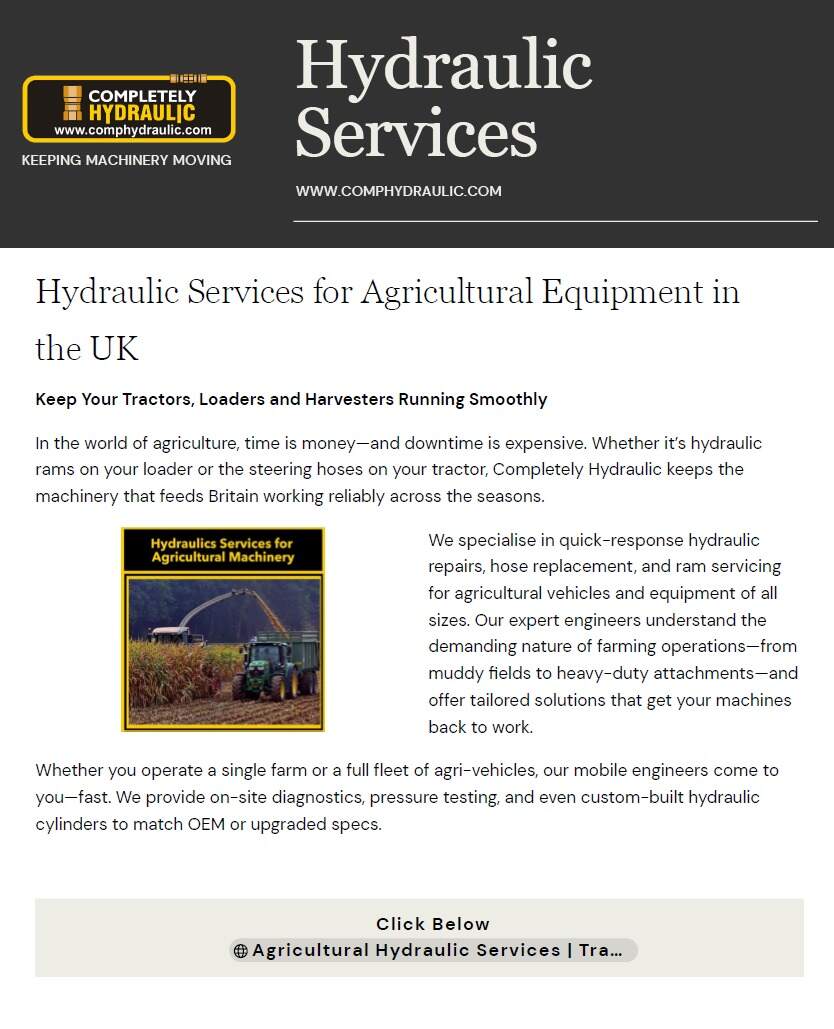
Download Our Agricultural Hydraulic Services Guide
For an overview of Completely Hydraulic’s agricultural hydraulic support, you can also download our agricultural services information.
Agricultural Hydraulic Services Information
Download our agricultural hydraulic services PDF for a convenient overview of the support available.
Frequently Asked Questions
Do you repair tractor hydraulic systems?
Completely Hydraulic provides support for suitable tractor and agricultural hydraulic faults, including hoses, cylinders, fittings, valves, leaks and wider hydraulic system diagnosis.
Can you replace a tractor hydraulic hose in the field?
Many failed hydraulic hoses can be replaced by a mobile hydraulic engineer where the machine is accessible and the correct hose and fittings are available. The replacement assembly must be suitable for the application.
Can you repair agricultural hydraulic rams?
Yes. Completely Hydraulic repairs and rebuilds hydraulic cylinders and rams. More extensive repairs are normally carried out in a specialist workshop where the cylinder can be dismantled and properly assessed.
Can you manufacture a replacement hydraulic cylinder for farm machinery?
For suitable applications, Completely Hydraulic can manufacture hydraulic cylinders where an original unit is obsolete, specialist or difficult to source.
Why is my tractor hydraulics slow?
Slow hydraulic operation can result from several causes including pump condition, restricted flow, valves, internal leakage, oil condition, filtration or temperature. Diagnosis is required before deciding which component needs repair.
What hydraulic oil should I use in my tractor?
Follow the machine manufacturer’s fluid specification. Viscosity grade is only one part of hydraulic fluid selection, and ISO VG 32, 46 or 68 should not be chosen solely according to season or ambient temperature.
Can different hydraulic oils be mixed?
Do not assume hydraulic fluids are compatible simply because they have similar viscosity grades. Compatibility and the manufacturer’s requirements should be confirmed before mixing fluids.
Why does the same hydraulic hose keep bursting?
Repeated hose failure can indicate routing, abrasion, twisting, heat, excessive movement, incorrect specification, fitting problems or pressure conditions. The underlying cause should be investigated rather than repeatedly replacing the hose alone.
Do agricultural hydraulic hoses have a fixed replacement age?
There is no universal replacement age suitable for every agricultural hose. Inspection and replacement should consider manufacturer guidance, condition, duty, environment, machine movement and failure history.
Do you provide emergency agricultural hydraulic repairs?
Completely Hydraulic provides 24/7 mobile hydraulic engineering for suitable breakdowns across its service areas.
How quickly can a mobile engineer reach a farm?
Response depends on engineer location, customer location, traffic, current demand, site access and the nature of the breakdown. A universal arrival time is not guaranteed.
Get Priority Hydraulic Support & Trade Pricing
Jump the queue. Reduce downtime. Pay less for parts, labour and callouts.
✔ Priority response
✔ Lower rates day & night
✔ Trade discounts on parts
✔ 30-day credit terms (approved accounts)
Agricultural Hydraulic Breakdown?
For tractor hoses, leaking rams, hydraulic faults or agricultural machinery repairs, contact Completely Hydraulic for mobile and workshop engineering support.