

How Long Do Hydraulic Hoses Last? Lifespan, Inspection & Replacement Signs
There is no single service life that applies to every hydraulic hose. How long a hose remains suitable for service depends on its specification, operating pressure and impulse cycles, temperature, fluid compatibility, routing, movement, abrasion, environment, installation, storage history and the condition found during inspection.
Updated: 6 October 2026
Quick Answer: How Long Does a Hydraulic Hose Last?
A hydraulic hose does not have one universal lifespan. Some applications are considerably harder on hoses than others. Replacement decisions should therefore consider the hose manufacturer’s guidance, machine requirements, operating hours or cycles, duty, environment, service history and physical condition rather than relying on one fixed number of years.
Get Priority Hydraulic Support & Trade Pricing
Jump the queue. Reduce downtime. Pay less for parts, labour and callouts.
✔ Priority response
✔ Lower rates day & night
✔ Trade discounts on parts
✔ 30-day credit terms (approved accounts)
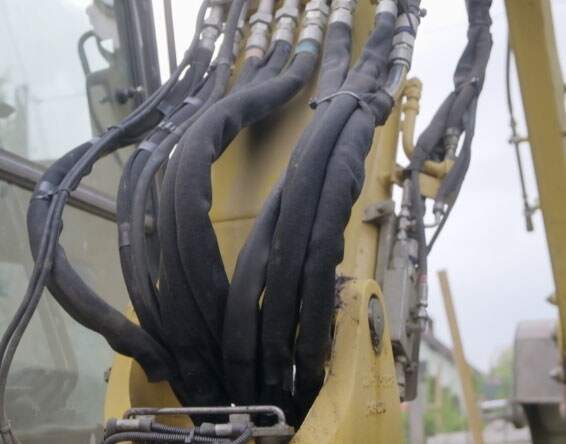
Why Hydraulic Hose Lifespan Cannot Be Reduced to One Number
Two apparently similar hydraulic hoses can experience very different working lives.
A hose on relatively stable industrial equipment may experience different stresses from a hose that continuously flexes on an excavator boom, forklift attachment, refuse vehicle or other mobile machine.
Service life can be influenced by:
- Hose construction and specification
- Working pressure and pressure cycles
- Pressure surges and system behaviour
- Fluid and ambient temperature
- Hydraulic fluid compatibility
- Machine movement and flexing
- Minimum bend radius
- Twisting
- Abrasion
- External contamination and chemicals
- UV and weather exposure
- Installation quality
- Storage before installation
- Maintenance and inspection history
Age Is Only Part of the Picture
Calendar age can be relevant, but it should not be considered in isolation. A hose’s actual condition and suitability depend on the application, operating history, environment and manufacturer or equipment requirements.
What Affects Hydraulic Hose Lifespan?
| Factor | How It Can Affect the Hose |
|---|---|
| Pressure & Impulse | Repeated pressure cycling and unsuitable pressure conditions can place additional stress on the hose assembly. |
| Temperature | Operating outside the hose manufacturer’s fluid or ambient temperature limits can accelerate deterioration. |
| Abrasion | Repeated rubbing can damage the outer cover and eventually expose or damage reinforcement. |
| Bend Radius | Bending more tightly than permitted can overstress the hose construction. |
| Twist | A twisted hose can be subjected to stresses it was not intended to accommodate. |
| Fluid Compatibility | An unsuitable fluid can affect the hose inner tube, seals or other assembly materials. |
| Environment | Heat, weather, chemicals, contamination and other external conditions may influence deterioration. |
| Installation | Poor routing, incorrect length, incompatible fittings or inadequate movement allowance can contribute to premature failure. |
Does a Higher-Pressure Hose Last Longer?
Not necessarily. A hose with a higher pressure rating is not automatically a better or longer-lasting replacement.
The hose should be correctly specified for the hydraulic system and application. Selection needs to consider much more than the maximum working-pressure figure, including hose construction, size, temperature, fluid compatibility, impulse requirements, fittings, routing and movement.
Do Not Use Burst Pressure as an Operating Target
A hose’s burst pressure is not the pressure at which the hydraulic system should normally operate. Hose selection should be based on the appropriate working-pressure rating and the complete requirements of the application.
Learn more in our Hydraulic Hose Pressure Ratings Guide.
Routing & Installation Have a Major Effect on Hose Life
Even a correctly specified hydraulic hose can suffer premature damage when its installation creates unnecessary stress.
Bend Radius
Follow the minimum bend radius specified for the particular hose series and size.
Twisting
Route the assembly so the hose flexes as intended rather than twisting along its length.
Abrasion
Avoid unnecessary rubbing against structures, moving parts and other hoses.
Machine Movement
Assess the route throughout the machine’s relevant range of movement rather than only while stationary.
See our Hydraulic Hose Installation Guide, Routing Guide and Bend Radius Guide.

How to Inspect a Hydraulic Hose
Regular visual inspection can identify deterioration before it develops into a more serious failure.
Depending on the equipment and application, look for:
- Abrasion or worn outer cover
- Exposed reinforcement
- Cracks or cuts
- Bulges or blisters
- Kinks or flattening
- Leaks or wet areas
- Damaged or corroded fittings
- Hose movement or rubbing
- Twisting
- Excessive tension
- Heat damage
- Loose or damaged clamps and supports
- Changes in hose flexibility or visible condition
Inspect the Route, Not Just the Hose
The surrounding machine can provide clues about why a hose is deteriorating. Check for rubbing points, movement, sharp edges, heat sources, damaged supports and other conditions that could shorten hose life.
Use our Hydraulic Hose Inspection Checklist for more guidance.
When Should a Hydraulic Hose Be Replaced?
A hose should not remain in service simply because it has not started leaking.
Conditions that can require professional assessment and replacement include:
| Condition | Why It Matters |
|---|---|
| Exposed Reinforcement | The protective cover has been compromised and reinforcement may also be damaged or exposed to corrosion. |
| Leakage | A leaking pressure hose assembly requires attention and should not simply be patched. |
| Bulges / Blisters | Visible deformation can indicate deterioration or damage within the hose construction. |
| Severe Abrasion | Continued wear can compromise the cover and reinforcement. |
| Kinking / Crushing | Deformation can damage the hose and interfere with normal operation. |
| Damaged Fittings | Corrosion, deformation, leakage or other fitting damage can compromise the assembly. |
Can You Repair a Worn Hydraulic Hose?
Damaged hydraulic pressure hose should generally be replaced as a correctly specified complete hose assembly rather than patched.
Replacement should also include consideration of why the original hose deteriorated. If poor routing, abrasion, heat, twist or another problem caused the damage, simply installing another hose in exactly the same position can repeat the failure.
Repeated Hose Failure Is a Diagnostic Clue
If the same hose repeatedly fails earlier than expected, investigate the application rather than treating each failure as an isolated event. Routing, specification, machine movement, abrasion, temperature and system pressure behaviour can all be relevant.
Should Hydraulic Hoses Be Replaced on a Fixed Schedule?
Not every machine or hose application should follow the same replacement schedule.
A suitable hose-management programme can consider:
- Equipment manufacturer recommendations
- Hose manufacturer guidance
- Operating hours and cycles
- Machine duty
- Environment
- Criticality of the hose
- Consequences of failure
- Inspection findings
- Previous failures
- Maintenance history
Some organisations may adopt planned replacement intervals for particular safety-critical or high-duty applications, while other hoses may be managed using condition, usage and manufacturer guidance.
There Is No Universal “Replace Every X Years” Rule
A fixed number quoted without knowing the hose, equipment, duty, manufacturer requirements and operating environment can be misleading. Use application-specific information and inspection rather than assuming every hydraulic hose has the same service life.
Does Hydraulic Hose Storage Affect Lifespan?
Yes. Hose condition can be influenced before it is ever installed.
Storage conditions can expose hose to factors such as heat, sunlight, ozone, moisture, chemicals, mechanical damage or unsuitable bending. Manufacturer guidance should therefore be followed for storage, handling and shelf-life considerations.
A hose that has spent time in storage should not automatically be treated as equivalent to a newly manufactured hose without considering its age, storage history and manufacturer requirements.
See our Hydraulic Hose Storage, Handling & Shelf Life Guide.
Can Hydraulic Hose Failure Be Predicted?
Condition monitoring can provide useful information about a hydraulic system, but it should not be assumed that a sensor or monitoring system can calculate an exact remaining lifespan for every hydraulic hose.
Depending on the equipment, monitoring may provide information about variables such as:
- System pressure
- Pressure behaviour
- Temperature
- Operating cycles
- Machine utilisation
- Other system-condition data
This information can support maintenance decisions and help identify changing operating conditions, but it should be considered alongside inspection, hose history, application requirements and manufacturer guidance.
Hydraulic Hose Inspection Safety
Hydraulic systems can retain dangerous stored energy even after the machine has stopped.
Never use your hand to search for a hydraulic leak. A fine stream of pressurised hydraulic fluid can penetrate the skin and cause a serious injection injury.
Suitable equipment-specific isolation and pressure-release procedures should be followed before hydraulic components are disturbed.
Never work beneath unsupported hydraulically raised equipment or loads.
A suspected hydraulic injection injury requires urgent medical attention.
Hydraulic Hose Inspection & Replacement from Completely Hydraulic
Completely Hydraulic supports businesses with hydraulic hose inspection, replacement, manufacture and emergency mobile hydraulic engineering.
Hose Inspection
Assessment of hose condition, routing, abrasion and other visible installation issues.
Hose Replacement
Correctly specified replacement hose assemblies for suitable mobile and industrial applications.
24/7 Mobile Support
Emergency hydraulic engineering support for suitable hose failures and breakdowns.
Failure Investigation
Repeated failures can be assessed for possible routing, abrasion, movement, heat, specification or wider hydraulic-system issues.
Our physical trade counters are located in Harlow, Dagenham, Belvedere and Hayes, with mobile hydraulic engineering support across our service areas.
Hydraulic Hose Lifespan FAQs
How long should a hydraulic hose last?
There is no universal lifespan for every hydraulic hose. Service life depends on hose specification, application, pressure cycles, temperature, routing, movement, environment, installation, maintenance and condition.
Do hydraulic hoses have an expiry date?
Manufacturer requirements can include shelf-life and service considerations, but a single universal expiry period should not be applied to every hydraulic hose. The particular hose, storage history and application need to be considered.
Should hydraulic hoses be replaced every few years?
There is no single replacement interval suitable for every hose. Follow applicable manufacturer and equipment guidance and consider operating hours or cycles, duty, environment, condition and failure consequences.
What are the signs of a worn hydraulic hose?
Warning signs can include abrasion, exposed reinforcement, cracks, cuts, leaks, bulges, blisters, kinks, fitting damage, heat damage and other visible deterioration.
Does a higher-pressure hydraulic hose last longer?
Not automatically. A hose should be correctly specified for the application. Higher pressure capability by itself does not guarantee longer service life.
Can hydraulic hose abrasion cause failure?
Yes. Repeated abrasion can wear through the outer cover and eventually expose or damage the hose reinforcement.
Does bend radius affect hydraulic hose lifespan?
Yes. Bending a hose more tightly than the manufacturer’s specified minimum bend radius can overstress the hose and contribute to premature damage.
Can a damaged hydraulic hose be repaired?
Damaged pressure hose should generally be replaced as a correctly specified complete hose assembly rather than patched.
Why does the same hydraulic hose keep failing?
Repeated failure can indicate an underlying problem such as abrasion, poor routing, excessive bending, twist, heat, movement, incorrect specification or unsuitable system conditions.
Can you predict exactly when a hydraulic hose will fail?
Condition and system monitoring can provide useful information, but an exact remaining service life cannot normally be assumed from a single measurement or monitoring system. Inspection, history, application and manufacturer guidance remain important.
Does storage affect hydraulic hose life?
Yes. Hose condition can be affected by storage time and conditions including heat, sunlight, ozone, moisture, chemicals and physical handling.
How often should hydraulic hoses be inspected?
Inspection frequency should reflect equipment and hose manufacturer guidance, operating hours or cycles, duty, environment, condition, previous failures and the consequences of hose failure rather than one universal interval.
Practical Hydraulic Advice for Your Business
Get useful hydraulic maintenance information, engineering guidance and Completely Hydraulic updates.
Related Hydraulic Hose Guides
- Hydraulic Hose Inspection Checklist
- Hydraulic Hose Inspection Service
- Hydraulic Hose Failure Causes & Prevention
- Hydraulic Hose Routing Guide
- Hydraulic Hose Bend Radius Explained
- Hydraulic Hose Protection Guide
- Hydraulic Hose Storage, Handling & Shelf Life
- Hydraulic Hose Installation Guide
- How Long Do Hydraulic Hoses Last?
Concerned About the Condition of Your Hydraulic Hoses?
Completely Hydraulic can help with hose inspection, replacement and emergency mobile hydraulic support for suitable industrial and mobile equipment.