
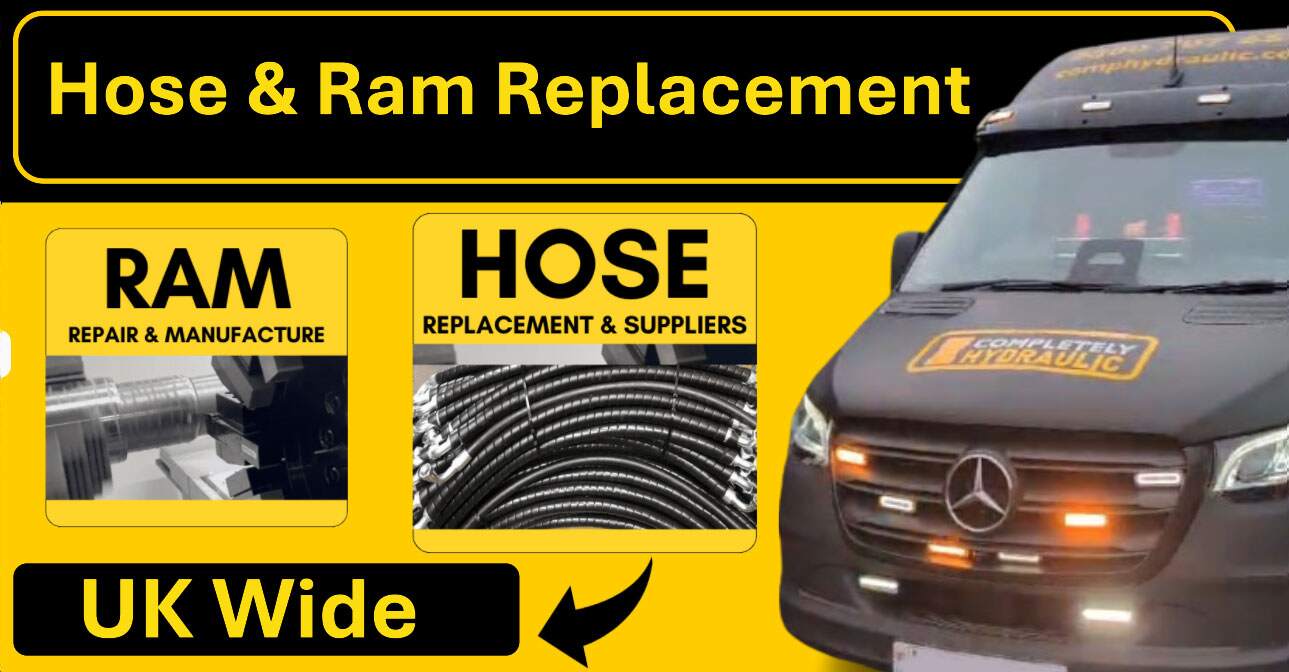
Hydraulic Hose & Ram Replacement: When to Repair, Replace or Rebuild
Completely Hydraulic provides 24/7 mobile hydraulic hose replacement and hydraulic ram and cylinder support across London, Essex, Kent, Heathrow and surrounding areas, with mobile engineering support across Birmingham and the West Midlands.
Updated: 2 October 2026
A burst hydraulic hose or leaking cylinder can stop machinery quickly, but one failed component does not automatically mean that both the hose and ram need replacing.
The correct approach is to assess the failure, identify its cause and determine whether the affected hose needs replacing and whether the cylinder should be repaired, rebuilt or replaced.
Quick Answer: Should You Replace a Hydraulic Hose & Ram Together?
Not automatically. If a hydraulic hose fails, the hose assembly should be assessed and replaced appropriately. If a hydraulic ram or cylinder is leaking or damaged, it should be separately inspected to determine whether repair, rebuilding or replacement is justified. Where the components operate together, inspecting the wider installation can help identify a common cause or prevent a repeat failure.
Get Priority Hydraulic Support & Trade Pricing
Jump the queue. Reduce downtime. Pay less for parts, labour and callouts.
✔ Priority response
✔ Lower rates day & night
✔ Trade discounts on parts
✔ 30-day credit terms (approved accounts)
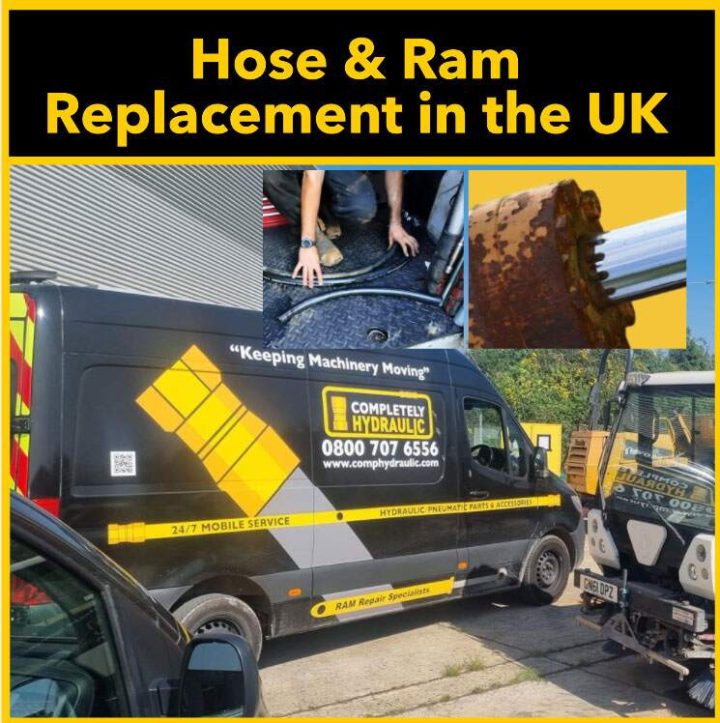
Hydraulic Hose Failure vs Hydraulic Ram Failure
Hydraulic hoses and cylinders work within the same hydraulic circuit, but they are different components and can fail for very different reasons.
| Component | Typical Problems | Possible Action |
|---|---|---|
| Hydraulic hose | Burst, abrasion, cracking, leakage, damaged fitting, poor routing or excessive bending | Replace the complete hose assembly with a suitable correctly specified assembly |
| Hydraulic ram / cylinder | External leakage, internal leakage, damaged rod, worn seals, bore damage or mechanical damage | Inspect and determine whether repair, rebuilding or replacement is appropriate |
| Repeated failure | Routing, side loading, contamination, pressure behaviour, installation or another system problem | Investigate the underlying cause rather than repeatedly replacing components |
When Should a Hydraulic Hose Be Replaced?
A damaged pressure hose should normally be replaced with a suitable complete hose assembly rather than patched for continued normal operation.
Reasons a hydraulic hose may need replacement include:
- A burst or significant leak
- Exposed or damaged reinforcement
- Severe abrasion
- Cracking or deterioration
- Damaged fittings or connections
- Kinking or crushing
- Heat damage
- Evidence of twisting
- Failure associated with unsuitable routing or bend radius
Correct replacement involves more than finding a hose that appears to be the same diameter. The hose, fittings and complete assembly need to be suitable for the application.
See our Hydraulic Hose Solutions and Hydraulic Hose Failure Causes & Prevention Guide.
Correct Hose Specification Matters
A replacement hydraulic hose assembly may need to account for:
- Nominal hose size
- Working pressure and system behaviour
- Hydraulic fluid compatibility
- Operating temperature
- Correct fittings and connection types
- Minimum bend radius
- Machine movement
- Abrasion and environmental exposure
- Routing and hose length
A hose with a higher pressure rating is not automatically a better replacement. The complete assembly needs to be appropriate for the machine and its hydraulic system.
When Does a Hydraulic Ram or Cylinder Need Attention?
A hydraulic cylinder may need investigation when it shows symptoms such as:
- Hydraulic fluid leaking around the rod or gland
- Failure to hold a load as expected
- Uncontrolled or excessive drift
- Visible rod damage
- Scoring or corrosion
- Jerky or inconsistent movement
- Reduced force or performance
- Mechanical damage
- Repeated seal failure
A Leaking Ram Does Not Automatically Need Replacing
The condition of the rod, seals, gland, bore and other components should be assessed. Depending on the cylinder and the extent of damage, rebuilding may be commercially preferable to replacement. In other cases, replacement may be the better option.
See our Hydraulic Ram Repair Service and Hydraulic Ram Replacement Guide.
Repair, Rebuild or Replace a Hydraulic Cylinder?
There is no single answer that applies to every hydraulic cylinder. The decision can depend on:
- Overall cylinder condition
- Rod and bore condition
- Availability of replacement parts
- Whether the cylinder is repairable
- Machine downtime
- Cost of repair compared with replacement
- Equipment criticality
- Safety considerations
- Whether the original cylinder is obsolete
For substantial cylinder repairs, dismantling, inspection, measurement and machining are normally better suited to workshop conditions than attempting a complete rebuild beside the machine.
24/7 Mobile Hydraulic Hose Replacement
Completely Hydraulic’s mobile engineers support suitable hydraulic breakdowns with on-site hose identification, hose manufacture and replacement.
Where conditions allow, the engineer can:
- Assess the failed hose assembly
- Identify the hose and connections
- Manufacture a suitable replacement hose assembly
- Install the replacement
- Inspect the immediate routing and installation
- Look for obvious abrasion, twisting, heat or bend-radius problems
Not every hydraulic component or hose assembly can necessarily be repaired or manufactured at the machine. Component availability, access, equipment condition and the nature of the failure can affect what can be completed during a mobile visit.
Hydraulic Hose Emergencies
Many failed hydraulic hose assemblies can be manufactured and replaced at the equipment location where the application, access and required components allow.
Hydraulic Ram & Cylinder Problems
An engineer can assess the immediate problem, but substantial cylinder rebuilding is normally carried out under appropriate workshop conditions.
Hydraulic Leak Safety
Never use your hand or fingers to search for a pressurised hydraulic leak.
High-pressure hydraulic fluid can penetrate the skin and cause a serious injection injury. Machinery should be safely isolated and stored hydraulic energy controlled before appropriate inspection or component removal.
If hydraulic fluid has penetrated the skin, seek urgent medical attention.
Why Do Hydraulic Hoses or Rams Keep Failing?
Repeated component failure is often a reason to investigate the wider installation rather than simply fit another replacement.
Possible contributors can include:
- Poor hose routing
- Hose twisting
- Insufficient bend radius
- Abrasion
- Excessive heat
- Pressure surges
- Contamination
- Incorrect component specification
- Cylinder misalignment or side loading
- Mechanical damage
- Installation problems
Inspect the Connected System — Don’t Automatically Replace Everything
When a hose or cylinder fails, inspecting connected components and the surrounding installation can reveal contributing problems. That does not mean every connected hose, cylinder or fitting automatically needs replacing.
Replacement & Custom Hydraulic Cylinders
Where an existing hydraulic cylinder is obsolete, unavailable or beyond economical repair, a correctly specified replacement or custom-manufactured cylinder may be an option.
Specification can involve:
- Bore diameter
- Rod diameter
- Stroke
- Mounting arrangement
- Port and connection details
- Operating pressure
- Required force and speed
- Duty cycle
- Materials
- Operating environment
The objective is to provide a cylinder correctly engineered for the application rather than make a blanket claim that a replacement is inherently “better than OEM”.
Equipment We Support
Hydraulic hose and cylinder support can be required across many types of machinery and industry, including:
- Excavators, loaders and dumpers
- Construction and plant equipment
- Waste and recycling machinery
- Forklifts and materials-handling equipment
- Agricultural machinery
- Commercial and specialist vehicles
- Marine and dockside equipment
- Industrial machinery
- Plant hire and fleet equipment
Mobile Hydraulic Support & Trade Counter Locations
Completely Hydraulic operates four physical hydraulic trade counters alongside its mobile engineering service:
Mobile hydraulic engineering support is also available across Birmingham and the West Midlands. Birmingham is a mobile engineering service rather than a physical CH trade counter.

Need a Cylinder Collected for Workshop Repair?
Where appropriate, Completely Hydraulic can collect hydraulic cylinders for workshop assessment and repair, helping businesses avoid arranging their own transport for suitable units.
Hydraulic Hose & Ram Replacement FAQs
Should I replace a hydraulic hose and ram at the same time?
Not automatically. Each component should be assessed individually. A hose failure does not prove that the cylinder needs replacing, and a leaking cylinder does not automatically mean its hoses need replacement.
Can a burst hydraulic hose be repaired?
A damaged pressure hose should normally be replaced with a suitable complete hose assembly rather than patched for continued normal service.
Can a hydraulic hose be replaced on site?
Many hydraulic hose assemblies can be manufactured and replaced by a mobile engineer at the machine where access, component availability and the application allow.
Can a leaking hydraulic ram be repaired?
Often, but it depends on the cylinder’s design and condition. The rod, seals, gland, bore and other components may need inspection before deciding whether rebuilding or replacement is appropriate.
Does a leaking cylinder only need new seals?
Not necessarily. Seal failure can be associated with rod damage, contamination, misalignment, side loading, bore or gland damage and other operating conditions.
When should a hydraulic cylinder be replaced instead of repaired?
Replacement may be appropriate when damage is extensive, repair is uneconomical, suitable parts are unavailable or a replacement provides a better solution for the machine and downtime requirements.
Why does my replacement hydraulic hose keep failing?
Repeat failures can be associated with routing, abrasion, twisting, excessive heat, incorrect bend radius, pressure behaviour, unsuitable specification or another system problem.
Can any hydraulic hose and fitting be used together?
No. Hose, fittings and assembly methods need to form a compatible system. Components should not be mixed simply because they appear to fit unless the combination is approved and validated for the application.
Can I check a hydraulic leak with my hand?
No. High-pressure hydraulic fluid can penetrate the skin and cause a serious injection injury. Never use your hand or fingers to locate a pressurised hydraulic leak.
Do you provide 24/7 emergency hydraulic repairs?
Yes. Completely Hydraulic provides 24/7 mobile hydraulic engineering support for suitable emergency breakdowns. Call 0800 707 6556 for assistance.
Related Hydraulic Services & Guides
Hydraulic Hose or Ram Failed?
Call Completely Hydraulic for mobile hydraulic hose replacement, cylinder assessment and workshop hydraulic ram repair. We’ll help establish what has failed and the appropriate repair or replacement route.