
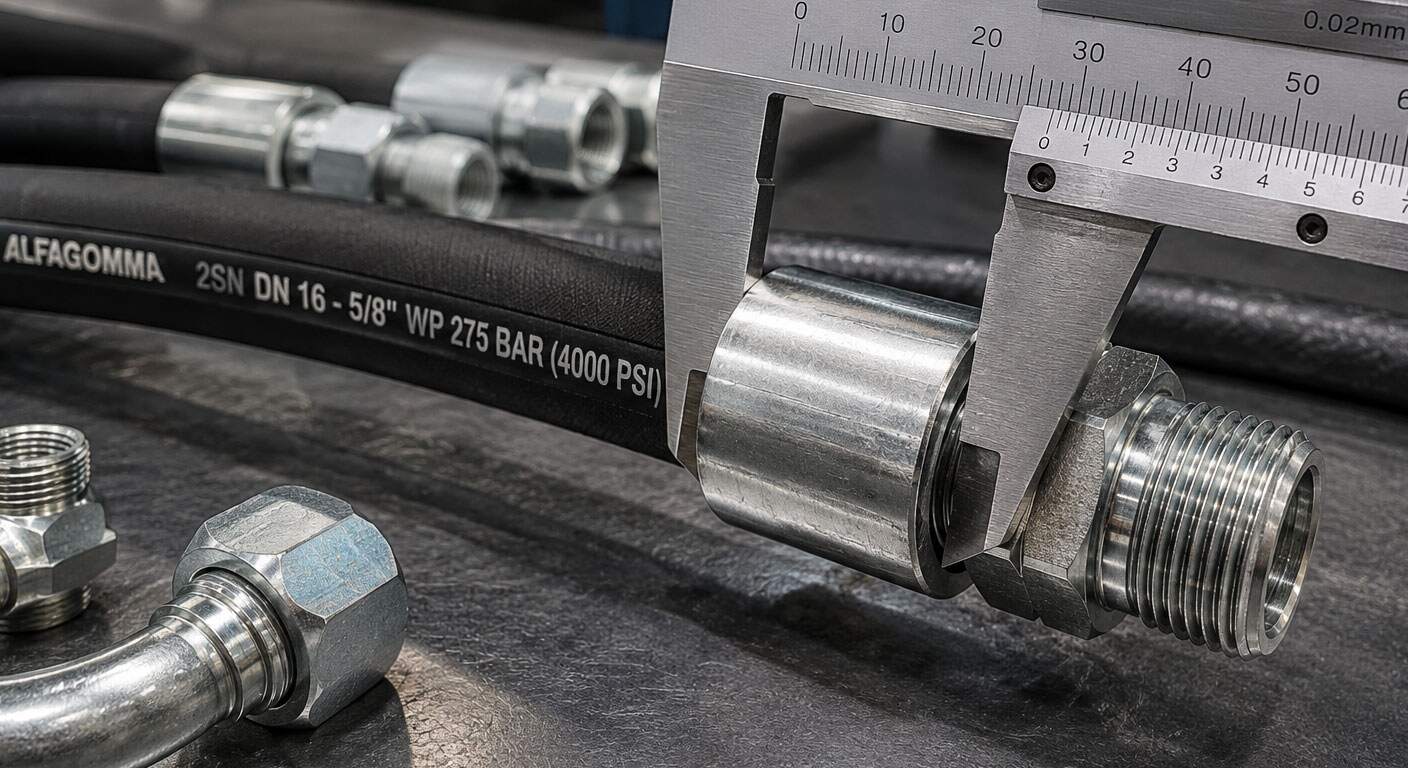
Hydraulic Hose Fittings Explained: BSP, JIC, ORFS & Metric
Learn how hydraulic hose fittings connect hoses to pumps, cylinders, valves and machinery, how common fitting types seal, and how to identify the correct connection.
Last Updated: 27 August 2026
Hydraulic hose fittings create the connection between a hydraulic hose assembly and the rest of the hydraulic system.
They may connect hoses to pumps, valves, cylinders, motors, manifolds, rigid pipework or other hose assemblies.
Using the wrong fitting can result in poor sealing, damaged threads, leakage, restriction or an unreliable hose assembly.
Common connection families encountered on hydraulic machinery include BSP, JIC, ORFS and Metric, but identifying the thread alone is not always enough. The sealing face, seat angle, thread pitch, size and fitting style also matter.
For a wider overview of hydraulic hose construction and selection, see our
hydraulic hoses comprehensive guide.
Not Sure Which Hydraulic Oil You Need?
Some machines require specialist or OEM-specific hydraulic oil. Using the wrong oil can cause serious damage.
Check Your Oil NowQuick Answer: What Are Hydraulic Hose Fittings?
Hydraulic hose fittings are the connection ends used to attach a hydraulic hose assembly to another hose or hydraulic component.
Common fitting systems include BSP, JIC, ORFS and Metric.
Each system can use a different thread and sealing method, so fittings that look similar should never be assumed to be interchangeable.
What Do Hydraulic Hose Fittings Do?
A hydraulic fitting forms part of the pressure-containing connection between the hose and the hydraulic system.
Correctly selected fittings help:
- Create secure hydraulic connections
- Provide the correct sealing interface
- Connect hoses to hydraulic components
- Allow hoses and components to be removed for servicing
- Maintain the required flow path
- Support reliable hose routing
Engineering Point
The thread does not always create the hydraulic seal. Depending on the fitting type, sealing may occur on a flare, cone, O-ring face, bonded seal or another dedicated sealing surface.
Common Hydraulic Fitting Types Explained
| Fitting Type | Typical Sealing Method | Where Commonly Encountered |
|---|---|---|
| BSP | Depends on fitting design; may use cone, bonded seal, O-ring or tapered-thread arrangement | UK, European and industrial hydraulic equipment |
| JIC | 37° flare seating surfaces | Mobile plant, industrial and imported machinery |
| ORFS | O-ring face seal | Mobile and industrial hydraulic systems where face-seal connections are specified |
| Metric | Varies by system; may use cone, O-ring or port seal | European machinery and specialist equipment |
| NPT / NPTF | Tapered thread system | Some North American and imported equipment |
Important: Similar-Looking Fittings Can Be Different
A BSP, Metric or NPT fitting can sometimes appear similar at first glance. Thread diameter alone is not enough to identify a connection correctly. Pitch, taper, seat geometry and sealing method also need to be checked.
What Is a BSP Hydraulic Fitting?
BSP stands for British Standard Pipe.
Two common thread forms are:
- BSPP – British Standard Pipe Parallel
- BSPT – British Standard Pipe Taper
BSPP uses a parallel thread, while BSPT uses a tapered thread.
The actual sealing method depends on the fitting or port design, so BSP connections should not be identified by thread form alone.
BSPP and BSPT Are Not the Same
Even where nominal sizes appear similar, parallel and tapered threads behave differently. The complete connection design should be identified before fitting components together.
What Is a JIC Hydraulic Fitting?
JIC hydraulic fittings use a 37-degree flare to form the sealing connection.
The thread pulls the two flare faces together, but the flare surfaces themselves provide the primary seal.
JIC connections are widely encountered in:
- Mobile plant
- Industrial machinery
- Agricultural equipment
- Transport hydraulics
- Imported hydraulic equipment
A damaged flare face can cause leakage even when the threaded connection appears tight.
What Is an ORFS Hydraulic Fitting?
ORFS means O-Ring Face Seal.
The connection uses an O-ring positioned in the face of the fitting to create the hydraulic seal.
The flat mating faces are drawn together by the threaded connection, compressing the O-ring to form the seal.
When inspecting an ORFS connection, check:
- O-ring condition
- Correct O-ring material and size
- Damage to the sealing face
- Contamination on the mating surfaces
- Thread condition
See our guide to hydraulic O-ring seals.
What Is a Metric Hydraulic Fitting?
Metric hydraulic fittings are widely used on European machinery.
However, “Metric” describes the thread system and does not by itself identify the complete hydraulic connection.
Metric fittings can use different:
- Thread pitches
- Seat angles
- O-ring arrangements
- Tube connection systems
- Port-sealing methods
Metric Thread Does Not Mean Universal Fit
Two fittings can both use metric threads while still having different pitches or sealing geometry. The complete fitting needs to be identified.
How Do You Identify a Hydraulic Hose Fitting?
Correct identification usually requires checking several features rather than relying on appearance alone.
01 — MALE OR FEMALE?
Identify the gender of the hydraulic connection.
02 — MEASURE THE THREAD
Measure the outside diameter of a male thread or relevant internal dimension of a female connection.
03 — CHECK THREAD PITCH
Use a suitable thread-pitch gauge or manufacturer chart where possible.
04 — IDENTIFY THE SEAL
Look for a flare, cone, O-ring face, bonded seal, tapered thread or other sealing arrangement.
05 — CONFIRM AGAINST KNOWN DATA
Compare measurements with manufacturer specifications, fitting charts or a known original component.
What Is the Difference Between a Hydraulic Fitting and an Adapter?
Hydraulic fitting is the broad term for a component used to create a hydraulic connection.
A hydraulic adapter is normally used to join or convert between existing connection types.
Adapters can be used to change:
- Thread type
- Connection size
- Male to female configuration
- Direction
- Port arrangement
Examples include:
- BSP to JIC
- Metric to BSP
- Straight adapters
- 90-degree elbows
- Tees
- Reducing adapters
For more detail, see our hydraulic adapters guide.
What Happens If the Wrong Hydraulic Fitting Is Used?
Incorrect fittings can cause problems ranging from obvious leakage to hidden thread or sealing damage.
Warning signs can include:
- Persistent hydraulic fluid leakage
- Difficulty engaging the thread
- Fitting becoming tight after only a small amount of engagement
- Damaged or distorted threads
- Damaged sealing faces
- Loose connections
- Repeated hose or fitting failure
Never Force a Hydraulic Thread
If a fitting does not engage correctly during initial assembly, stop and recheck the thread and connection type. Forcing mismatched fittings together can damage both components and create an unreliable joint.
Do Hydraulic Fittings Have Pressure Ratings?
Yes.
Hydraulic fitting and adapter capability depends on factors including:
- Connection design
- Size
- Material
- Manufacturer specification
- Application
The complete hose assembly should be suitable for the required hydraulic working pressure.
The Lowest Rated Component Can Limit the Assembly
A hose with a high working-pressure rating does not make the complete assembly suitable for that pressure if a fitting, adapter or coupling has a lower permitted rating.
Can Any Hydraulic Fitting Be Crimped Onto Any Hydraulic Hose?
No.
Hydraulic hose, couplings and crimp dimensions are commonly designed as a matched assembly system.
The fitting stem, ferrule and hose construction must be compatible with the manufacturer’s approved crimp specification.
Do not assume components from different manufacturers can be mixed simply because they appear to fit.
Hose + Fitting + Crimp Specification
A hydraulic hose assembly should be considered as one engineered pressure-containing system. The hose, fitting and crimp dimensions all need to work together correctly.
Get Priority Hydraulic Support & Trade Pricing
Jump the queue. Reduce downtime. Pay less for parts, labour and callouts.
✔ Priority response
✔ Lower rates day & night
✔ Trade discounts on parts
✔ 30-day credit terms (approved accounts)
Why Do Hydraulic Hose Fittings Come in Different Angles?
Hydraulic hose fittings are available in straight and angled configurations to help route hoses around machinery.
Common configurations include:
- Straight
- 45-degree
- 90-degree
Correct fitting orientation can help reduce unnecessary hose bending and improve connection alignment.
However, fitting angle should be considered together with hose length, bend radius and machine movement.
See our hydraulic hose routing guide.
How Are Two Hydraulic Hoses Connected?
Two hose assemblies can be connected using a correctly specified union, coupling or hydraulic adapter.
The connection must match:
- Fitting type
- Thread size
- Sealing method
- Pressure capability
- Hose and system requirements
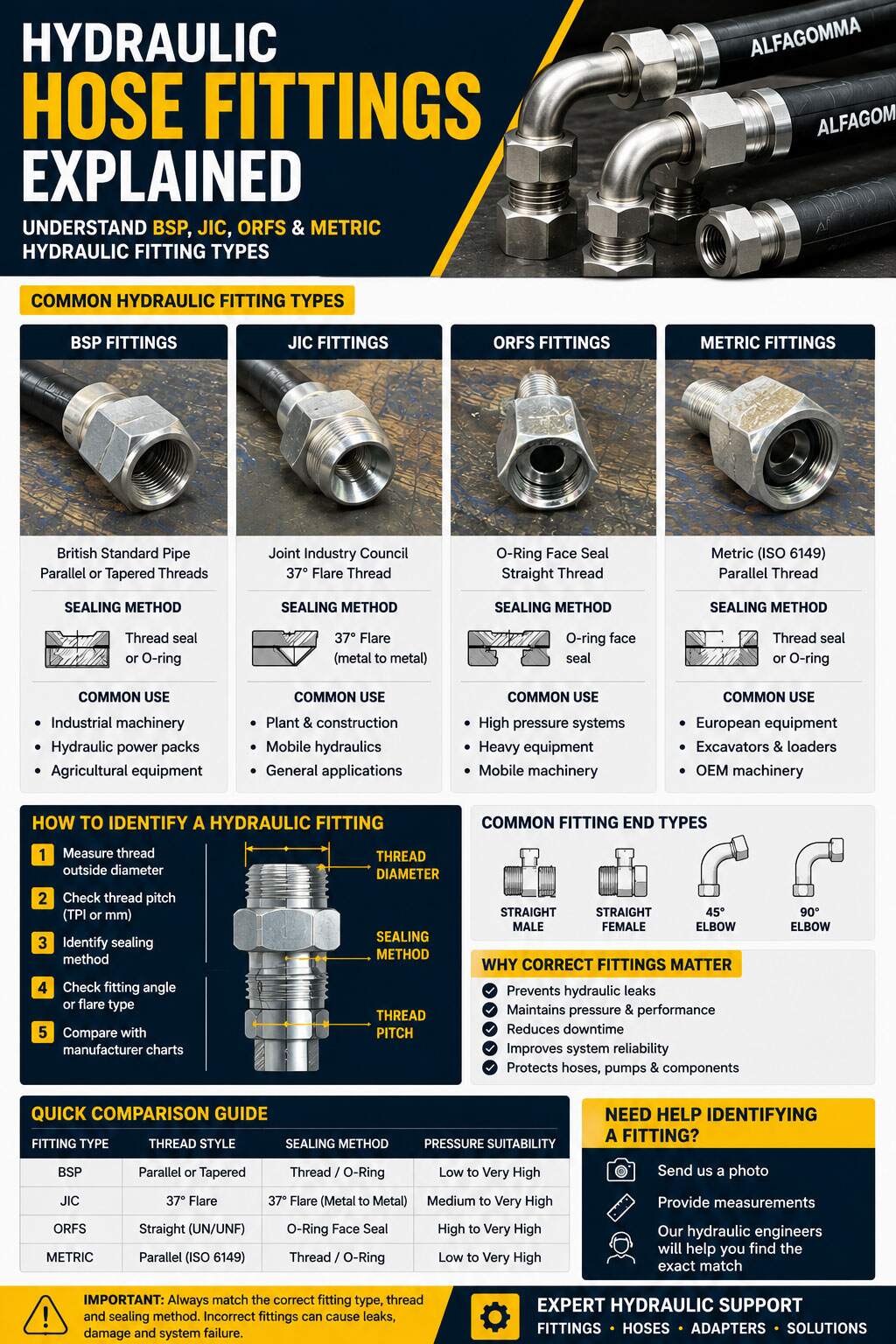
Hydraulic Hose Fittings at a Glance
Need a fast hydraulic repair quote?
Tell us what’s failed — we’ll get back to you quickly.
Get a Fast Quote →Need Help Identifying a Hydraulic Fitting?
If you cannot identify a hose fitting confidently, Completely Hydraulic can help identify the connection and suitable replacement options.
Useful information includes:
- Clear photographs of the fitting
- Thread outside diameter
- Thread pitch if known
- Male or female connection
- Hose size or layline information
- Machine make and model
- The original fitting or hose assembly where available
Bring the Old Hose or Fitting
Where it can be removed safely, bringing the original hose or fitting to one of our hydraulic trade counters can make identification considerably easier.
Hydraulic Fitting Safety
Hydraulic fittings can carry fluid at substantial pressure.
Never Search for a Hydraulic Leak With Your Hand
High-pressure hydraulic fluid can penetrate the skin and cause serious injection injury. The system should be safely depressurised before fittings or hose assemblies are disturbed.
Quick Hydraulic Fitting Summary
BSP
Common UK and European connection family using parallel or tapered thread forms.
JIC
Uses a 37-degree flare sealing surface.
ORFS
Uses an O-ring in the face of the fitting.
METRIC
Uses metric threads but can involve several different sealing systems.
IDENTIFICATION
Check thread diameter, pitch, gender and sealing geometry.
KEY RULE
Never assume two hydraulic fittings are interchangeable because they look similar.
Related Hydraulic Hose & Fitting Guides
Need a Hydraulic Fitting Identified?
Bring your hose or fitting to one of our hydraulic trade counters, or speak to Completely Hydraulic if your machinery is already down and requires mobile hose support.
Hydraulic Hose Fittings FAQs
What are the most common hydraulic hose fitting types?
Common hydraulic fitting families include BSP, JIC, ORFS and Metric connections. NPT and other fitting systems are also encountered on some machinery.
What is the difference between BSP and JIC fittings?
BSP refers to a British Standard Pipe thread family, while JIC uses a 37-degree flare sealing surface. They use different connection geometry and should not be treated as interchangeable.
What does ORFS mean?
ORFS means O-Ring Face Seal. An O-ring in the face of the fitting creates the hydraulic seal when the mating surfaces are connected.
How can I identify an unknown hydraulic fitting?
Identify whether it is male or female, measure the thread diameter and pitch, determine whether the thread is parallel or tapered, and inspect the sealing surface or seat geometry.
Can BSP and Metric fittings look similar?
Yes. Some hydraulic fittings can appear very similar even though their thread pitch or sealing system differs. They should be measured and identified rather than matched visually.
Can BSP and JIC be connected together?
Yes, where a correctly specified BSP-to-JIC hydraulic adapter is used. They should not be forced together directly because they use different connection systems.
Can any hydraulic fitting be crimped onto any hose?
No. Hydraulic hose, fittings and crimp specifications are commonly designed as a matched system. Use only combinations approved for the particular hose assembly.
Why is my hydraulic fitting leaking?
Possible causes include damaged seals, incorrect fitting type, damaged sealing faces, loose connections, corrosion, thread damage, incorrect assembly or poor alignment.
Do hydraulic fittings have pressure ratings?
Yes. Pressure capability depends on the fitting design, size, material and manufacturer specification. The complete assembly should be suitable for the hydraulic system’s operating requirements.
Can Completely Hydraulic identify hydraulic fittings?
Yes. Completely Hydraulic can help identify hydraulic hose fittings, adapters and connection types through its trade counters and hydraulic engineering network.