
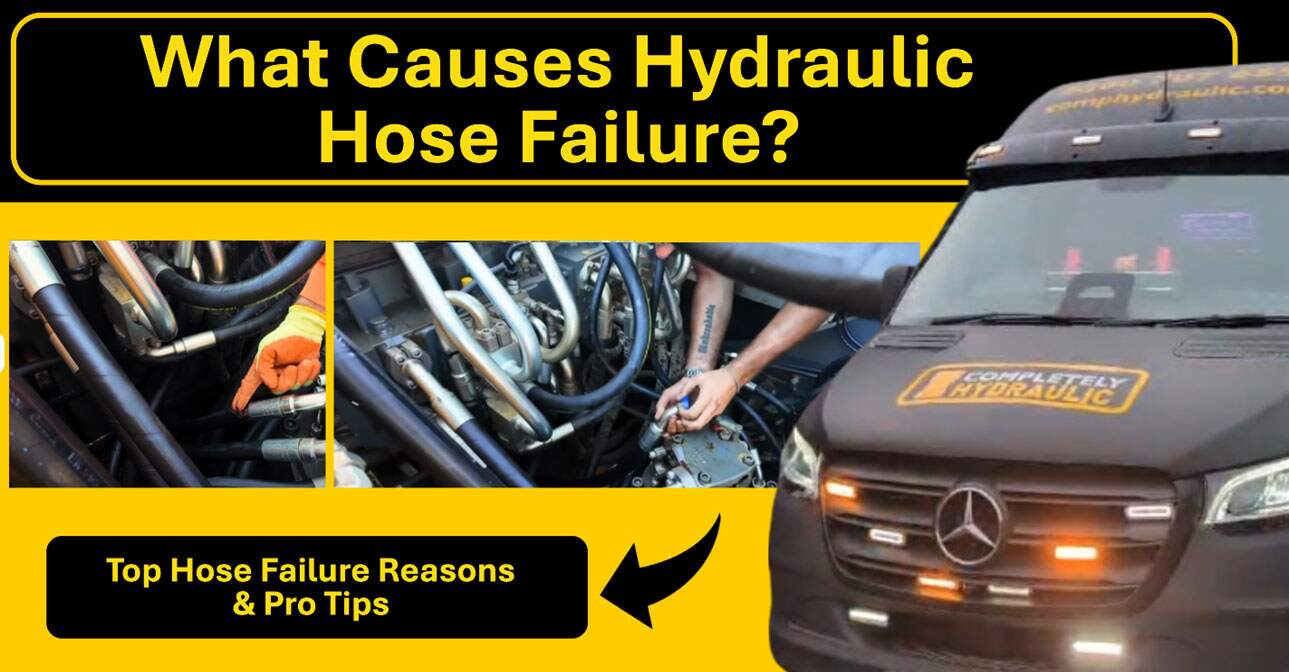
Hydraulic Hose Failure: Common Causes, Warning Signs & Prevention
A hydraulic hose can fail because of abrasion, heat, incorrect routing, unsuitable hose selection, damaged fittings, excessive pressure, contamination or normal deterioration over time.
Last Updated: 27 August 2026
Hydraulic hoses carry pressurised fluid between pumps, valves, cylinders, motors and other components.
When a hose fails, even a relatively small component can stop an entire machine, release hydraulic oil and create an urgent maintenance problem.
Understanding why hydraulic hoses fail is important because simply replacing a damaged hose without correcting the cause can lead to repeated failures.
If your machinery is already down, Completely Hydraulic provides
hydraulic hose repair and replacement
and
24/7 mobile hydraulic support.
Not Sure Which Hydraulic Oil You Need?
Some machines require specialist or OEM-specific hydraulic oil. Using the wrong oil can cause serious damage.
Check Your Oil NowQuick Answer: What Causes Hydraulic Hose Failure?
Common hydraulic hose failure causes include abrasion, excessive heat, incorrect bend radius, twisting, poor routing, incorrect hose or fitting selection, unsuitable crimping, pressure outside the hose rating and environmental deterioration.
Regular inspection, correct hose specification, proper routing and professional hose assembly can reduce many avoidable failures.
Top Causes of Hydraulic Hose Failure
| Cause | What You May See | How Risk Can Be Reduced |
|---|---|---|
| Abrasion | Worn cover, rubbing marks or exposed reinforcement | Improve routing and use suitable clamps, sleeves or guards where required |
| Heat | Hard, brittle, cracked or discoloured hose cover | Use hose suitable for the temperature and reduce unnecessary heat exposure |
| Incorrect Bend Radius | Flattening, kinking or damage close to fittings | Follow the hose manufacturer’s minimum bend-radius requirement |
| Twisting | Spiral distortion or unusual hose movement | Install fittings and route the hose without torsional loading |
| Incorrect Hose or Fittings | Leaks, early failure or damage near the coupling | Match pressure, size, temperature, fluid and fitting specification |
| Incorrect Assembly or Crimp | Leakage or separation near the fitting | Use approved hose, fitting and crimp combinations |
| Excessive Pressure | Burst hose, reinforcement failure or sudden rupture | Use an assembly rated for the hydraulic system’s operating requirements |
| Age & Environment | Cracks, weathering, hardening or general deterioration | Inspect condition and replace deteriorating hose before failure |

1. Hydraulic Hose Abrasion
Abrasion occurs when a hydraulic hose repeatedly rubs against another hose, a machine structure or another surface.
Over time, this can wear through the outer cover and expose the reinforcement beneath it.
Common abrasion points include:
- Hose-to-hose contact
- Sharp machine edges
- Unprotected brackets
- Moving parts
- Incorrectly positioned clamps
- Areas where the hose flexes repeatedly
Engineering Point
Replacing an abraded hose without correcting the contact point can result in the replacement hose suffering the same damage.
2. Excessive Heat
Hydraulic hose materials are designed to operate within specified temperature limits.
Excessive heat can accelerate ageing and affect the outer cover, internal tube and other hose materials.
Heat exposure can come from:
- Hot hydraulic oil
- Engines
- Exhaust systems
- Industrial process heat
- Poor ventilation
- Hydraulic systems operating above intended temperature
Heat Damage Can Be a System Warning
If several hoses appear heat-damaged, the problem may not simply be hose location. Hydraulic oil temperature and wider system operation may also need to be investigated.
3. Incorrect Bend Radius
Every hydraulic hose has a minimum bend radius specified by its manufacturer.
Bending a hose more tightly than this can place excessive stress on the reinforcement and internal structure.
Problems are especially common where a hose bends sharply immediately behind a fitting.
A Longer Hose Is Not Always the Answer
Correct routing requires enough hose length for movement and bend radius without creating excessive slack that can rub, snag or interfere with the machine.
See our hydraulic hose routing guide.
4. Hose Twisting
A hydraulic hose is designed to flex, but it should not normally be installed under torsional load.
Twisting can place additional stress on:
- Hose reinforcement
- The internal tube
- Crimped connections
- Fitting alignment
Where angled fittings are used, their orientation should be considered before final assembly and tightening.
5. Incorrect Hydraulic Hose Selection
A hose should be selected according to the actual hydraulic application.
Important factors include:
- Internal diameter
- Working-pressure rating
- Fluid compatibility
- Temperature range
- Minimum bend radius
- Required fittings
- Machine movement
- Environmental exposure
Do Not Choose Hose by Appearance Alone
Two hoses can look very similar while having different reinforcement, working-pressure capability, temperature limits or fluid compatibility.
See our hydraulic hose selection guide.
6. Incorrect Fittings or Hose Assembly
The hydraulic hose, coupling and crimp dimensions need to work together as one pressure-containing assembly.
Problems can occur if:
- The wrong fitting series is used
- The hose and fitting are not approved as a compatible combination
- The crimp diameter is incorrect
- The fitting is inserted incorrectly
- Threads or sealing faces are damaged
- The fitting has been incorrectly identified
See our hydraulic hose fittings guide.
7. Pressure Above the Hose Assembly Rating
A hydraulic hose assembly must be suitable for the pressure conditions of the system.
The complete assembly includes:
- Hydraulic hose
- Hose fittings
- Adapters
- Couplings where fitted
The pressure capability of the assembly can be limited by its lowest-rated component.
Pressure Spikes Matter Too
A hydraulic system can experience short-duration pressure spikes that are higher than its normal running pressure. Hose selection should follow the relevant machine and manufacturer requirements rather than normal operating pressure alone.
8. Hydraulic Fluid Contamination
Contamination is primarily a wider hydraulic-system issue rather than one of the most common direct causes of external hose-cover failure.
However, contamination can still matter during hose replacement and system repair.
Particles and debris can:
- Travel through newly fitted hose assemblies
- Damage valves and pumps
- Restrict small hydraulic passages
- Contaminate replacement components
New or replacement hose assemblies should be handled cleanly, and appropriate flushing or filtration may be required where contamination is already present in the system.
See our hydraulic hose flushing services.
How Can You Spot Hydraulic Hose Damage Before Failure?
Hydraulic hoses should be inspected for changes that suggest deterioration or mechanical damage.
Warning signs can include:
- Oily residue around fittings
- Visible fluid leakage
- Cracks in the outer cover
- Abrasion or rubbing marks
- Exposed reinforcement
- Bulges or blisters
- Kinks or flattening
- Loose or corroded fittings
- Hose pulling away from the coupling
- Unusual twisting
- Heat-hardened or brittle hose cover
Hydraulic Safety Warning
Never use your hand to search for a pressurised hydraulic leak. High-pressure hydraulic fluid can penetrate the skin and cause a serious injection injury. The equipment should be safely isolated and depressurised before inspection or repair.
Need a fast hydraulic repair quote?
Tell us what’s failed — we’ll get back to you quickly.
Can Hydraulic Hose Failure Be Repaired On Site?
In many cases, yes.
A mobile hydraulic engineer may be able to:
- Identify the failed hose
- Identify the fittings and adapters
- Confirm hose size and specification
- Manufacture a replacement hose assembly
- Install the replacement where practical
- Inspect the surrounding routing for obvious causes of failure
The machine, site access, safety conditions and wider hydraulic fault all influence what can be completed on site.
How to Prevent Future Hydraulic Hose Failures
01 — INSPECT
Look for leakage, abrasion, cracking, bulges and fitting damage.
02 — SELECT
Use hose and fittings suitable for pressure, temperature, fluid and machine movement.
03 — ROUTE
Avoid excessive bending, twisting, sharp edges and unnecessary rubbing.
04 — PROTECT
Use suitable clamps, sleeves or guarding where the application requires them.
05 — INVESTIGATE
If hoses repeatedly fail in the same location, identify the underlying cause rather than repeatedly replacing the hose.
06 — REPLACE WHEN CONDITION REQUIRES IT
Remove badly deteriorated or damaged hose assemblies from service before they become unplanned failures.
Can Preventative Maintenance Reduce Hydraulic Hose Failures?
Planned hydraulic maintenance can help identify deteriorating hoses before they fail unexpectedly.
Inspection can include:
- Hose condition
- Routing
- Fitting condition
- Abrasion points
- Clamps and supports
- Leaks
- Heat exposure
- Machine movement around hoses
Preventative Maintenance Helps Reduce Avoidable Downtime
Maintenance cannot guarantee that a hose will never fail, but regular inspection can identify wear and deterioration early enough for planned replacement where appropriate.
Get Priority Hydraulic Support & Trade Pricing
Jump the queue. Reduce downtime. Pay less for parts, labour and callouts.
✔ Priority response
✔ Lower rates day & night
✔ Trade discounts on parts
✔ 30-day credit terms (approved accounts)
Why Does the Same Hydraulic Hose Keep Failing?
If the same hose repeatedly fails, there is usually a reason.
Possible causes include:
- Incorrect routing
- Repeated abrasion
- Hose too short
- Hose too long and rubbing
- Incorrect bend radius
- Machine movement not accounted for
- Incorrect fitting orientation
- Excessive operating temperature
- Incorrect hose specification
- Pressure conditions outside the assembly requirement
Repeated Failure Needs Investigation
A replacement hose should not simply be copied from the failed assembly if there is evidence that the original routing, length, fitting orientation or specification contributed to the problem.
How Long Should a Hydraulic Hose Last?
There is no single service life that applies to every hydraulic hose.
Hose life depends on factors such as:
- Pressure
- Temperature
- Flexing
- Routing
- Abrasion
- Environmental exposure
- Fluid compatibility
- Hose construction
- Maintenance
This is why hose condition and application matter more than relying on an arbitrary age alone.
See our guide: How Long Do Hydraulic Hoses Last?
Hydraulic Hose Repair Coverage
Completely Hydraulic provides mobile hydraulic hose support across its core service areas, including:
- Hydraulic hose repair in London
- Hydraulic hose repair in Essex
- Hydraulic hose repair in Kent
- Hydraulic hose repair at Heathrow
For wider emergency support, see our 24/7 mobile hydraulic service.
Hydraulic Hose Failure: Quick Summary
ABRASION
Repeated rubbing can wear through the hose cover and expose reinforcement.
HEAT
Excessive temperature can accelerate deterioration of hose materials.
ROUTING
Twisting, excessive bending and poor alignment can shorten hose life.
SPECIFICATION
Hose, fittings, pressure, temperature and fluid compatibility must match the application.
INSPECTION
Leaks, cracks, bulges, abrasion and damaged fittings should be investigated early.
REPEATED FAILURE
If the same hose repeatedly fails, find the underlying cause instead of simply fitting another identical hose.
Related Hydraulic Hose Guides & Services
Need a Hydraulic Hose Fixed?
If a hydraulic hose has burst, started leaking or is showing serious damage, Completely Hydraulic can help identify the correct replacement and provide mobile hydraulic support where required.
Hydraulic Hose Failure FAQs
What is the most common cause of hydraulic hose failure?
There is no single cause in every application, but abrasion, poor routing, excessive bending, heat, unsuitable hose selection and fitting or assembly problems are common contributors.
What causes a hydraulic hose to burst?
A burst can be caused by pressure outside the hose assembly’s capability, severe abrasion, damaged reinforcement, ageing, heat damage, incorrect assembly or another form of structural deterioration.
Can a hydraulic hose be repaired?
In most high-pressure hydraulic applications, a damaged hose assembly is normally replaced rather than patched. The replacement should use the correct hose, fittings and assembly specification.
Can a hydraulic hose be replaced on site?
Yes. Many hydraulic hose failures can be assessed and replacement hose assemblies produced and fitted by a mobile hydraulic engineer where site conditions allow.
How do you prevent hydraulic hose failure?
Use correctly specified hose and fittings, route hoses without twisting or excessive bending, prevent abrasion, inspect hoses regularly and investigate repeated failures rather than simply replacing the damaged assembly.
When should a hydraulic hose be replaced?
A hose should be assessed for replacement if it has visible leakage, serious abrasion, exposed reinforcement, bulges, cracks, heat damage, damaged fittings or other signs that its condition is no longer suitable for service.
Why does the same hydraulic hose keep failing?
Repeated failure may indicate incorrect routing, abrasion, wrong hose length, excessive bending, heat exposure, pressure issues, unsuitable fittings or the wrong hose specification.
Can contaminated hydraulic oil damage a hose?
Contamination is more commonly associated with wear and malfunction in precision hydraulic components, but contamination can also affect the wider system and should be controlled during hose replacement and servicing.
Is hydraulic hose leakage dangerous?
Yes. Pressurised hydraulic fluid can cause serious injection injuries and can also create slip, fire or environmental risks depending on the fluid and application. Never search for a hydraulic leak using your hand.
Does Completely Hydraulic provide emergency hydraulic hose repair?
Yes. Completely Hydraulic provides mobile hydraulic hose replacement and 24/7 hydraulic breakdown support across its service areas.