
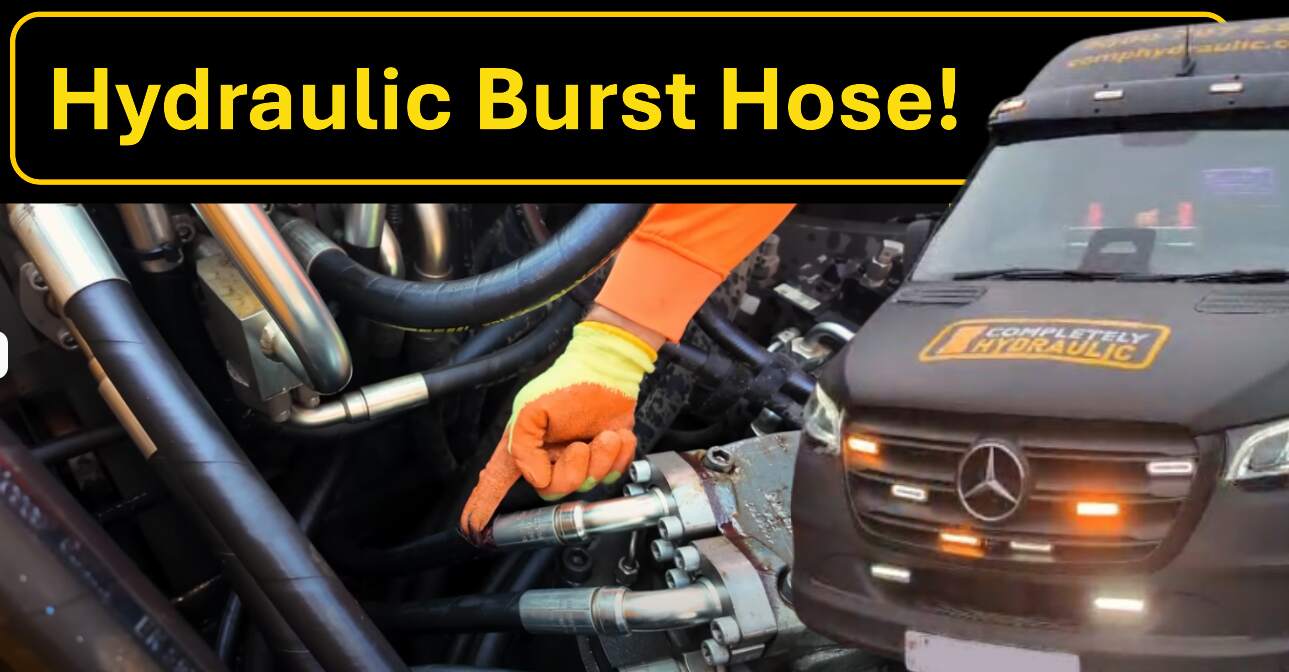
Hydraulic Hose Burst: What to Do in an Emergency
Updated: 19 September 2026
A burst hydraulic hose can release oil at high pressure, stop machinery without warning and create serious safety, environmental and downtime problems. If a hydraulic hose has split, ruptured or started spraying or leaking fluid, stop the machine, make the area safe and do not approach or touch a pressurised leak.
Completely Hydraulic provides 24/7 emergency mobile hydraulic hose support across London, Essex, Kent, Heathrow and surrounding service areas, with mobile engineering support also available across Birmingham and the West Midlands.
Stop the machine safely, keep people away from the leak, make supported loads safe and isolate the hydraulic system in accordance with the equipment procedure. Never use your hand to locate a pressurised leak and do not attempt to patch a failed pressure hose. For emergency mobile hydraulic support, call Completely Hydraulic on 0800 707 6556.
Get Priority Hydraulic Support & Trade Pricing
Jump the queue. Reduce downtime. Pay less for parts, labour and callouts.
✔ Priority response
✔ Lower rates day & night
✔ Trade discounts on parts
✔ 30-day credit terms (approved accounts)
A small high-pressure hydraulic leak may be difficult to see and can penetrate skin. Keep clear of suspected pressurised leaks, isolate the equipment appropriately and have the fault assessed safely.

Signs of a Burst or Failed Hydraulic Hose
A hydraulic hose does not always fail with an obvious dramatic rupture. Some failures begin with a small leak, damaged outer cover or deteriorating fitting before becoming more serious.
Warning signs can include:
- Visible split or rupture in the hose
- Hydraulic oil leaking or spraying
- Oil mist around a hose or fitting
- Sudden loss of hydraulic function
- Reduced system performance
- Unexpected or erratic actuator movement
- Rapid loss of hydraulic oil
- Bulging or blistering of the hose
- Exposed reinforcement
- Damaged or displaced fittings
- Fresh pools of hydraulic oil beneath machinery
If a hydraulic hose is suspected of failing, continuing to operate the machine can worsen the damage and increase the amount of oil released.
What to Do Immediately After a Hydraulic Hose Bursts
| Step | Action |
|---|---|
| 1 | Stop the machine safely. Do not continue operating equipment with a known hydraulic hose failure. |
| 2 | Keep people away. Restrict access to the affected area, particularly where oil may still be under pressure. |
| 3 | Make loads safe. Hydraulic equipment may support raised or suspended loads. Follow the equipment’s safe shutdown and isolation procedure. |
| 4 | Isolate the hydraulic system appropriately. Stored hydraulic energy may remain after the machine has stopped. |
| 5 | Contain spilled oil where safe to do so. Prevent hydraulic fluid from spreading into drains, soil or watercourses where this can be done without approaching the hazardous leak. |
| 6 | Arrange the correct repair. Call Completely Hydraulic on 0800 707 6556 for 24/7 emergency mobile hydraulic support. |
What Should You NOT Do With a Burst Hydraulic Hose?
Emergency breakdown pressure can lead to unsafe temporary fixes. A failed pressure hose should be treated as a failed hydraulic component.
- Do not search for a leak using your hand.
- Do not wrap a burst pressure hose with tape.
- Do not use a clamp as a temporary pressure-hose repair.
- Do not continue operating a visibly damaged hose.
- Do not assume the system is depressurised simply because the engine or motor has stopped.
- Do not replace a hose without considering why it failed.
A failed high-pressure hydraulic hose should normally be replaced with a complete suitable hose assembly rather than patched with tape, clamps or another improvised repair. The replacement hose and fittings must be appropriate for the hydraulic system and application.
24/7 Emergency Hydraulic Hose Repair
When machinery cannot be moved or the failed hose needs to be removed and replaced on site, our 24/7 mobile hydraulic engineering service provides an on-site repair route.
Depending on the breakdown and site conditions, the engineer can:
- Assess the reported hydraulic failure
- Identify the failed hose and connections
- Safely remove the damaged assembly where appropriate
- Identify suitable hose and compatible fittings
- Produce a replacement hose assembly from available van stock
- Install the replacement
- Inspect associated routing and visible components
- Carry out appropriate operational checks before the repair is returned to service
Not every breakdown can be resolved solely by replacing the hose. If the failure indicates another hydraulic or mechanical problem, further diagnosis or workshop support may be required.
How Is a Replacement Hydraulic Hose Selected?
A replacement hydraulic hose should not be selected simply because it has the same outside diameter as the failed hose.
Important considerations can include:
- Nominal hose bore
- Working pressure requirement
- Hose construction
- Fluid compatibility
- Temperature
- End fittings
- Connection standard
- Overall length
- Routing
- Minimum bend radius
- Movement of the machine
- Environmental conditions
Where readable, the hydraulic hose layline may provide useful information about the existing hose.
Our hydraulic hose size guide and hydraulic hose pressure guide explain two of the most important specification areas.
Why Do Hydraulic Hoses Burst?
A hose rupture is often the final result of damage or deterioration that has developed over time.
Common contributors include:
- Abrasion
- Incorrect hose specification
- Excessive heat
- Incorrect routing
- Hose twisting
- Operating below the required bend radius
- Pressure surges or impulse loading
- Age and environmental deterioration
- Incorrect assembly
- Incompatible hose and fittings
- External impact
- Contamination
- Movement or rubbing against surrounding components
For a detailed breakdown, see Hydraulic Hose Failure Causes & Prevention.
Why Hose Routing Matters
A correctly specified hose can still fail prematurely if it is badly routed.
Problems can occur where a hose:
- Rubs against metalwork
- Is twisted during installation
- Is pulled tight at full machine movement
- Bends too close to the fitting
- Operates below its minimum bend radius
- Passes too close to excessive heat
- Is unsupported where movement needs controlling
The replacement should therefore be considered across the machine’s full operating movement, not just while the equipment is stationary.
See our hydraulic hose routing guide and hydraulic hose bend radius guide.
Hydraulic Hose Burst at the Fitting
Failures near a hose fitting can result from several possible causes, including hose movement, routing, assembly issues, bending too close to the fitting, damage or incompatibility.
A fitting that appears to connect correctly is not automatically suitable.
Hydraulic connections can use different:
- Threads
- Thread pitches
- Seat forms
- Sealing methods
- Connection standards
Our hydraulic hose fittings guide explains the main considerations.
Can You Reuse the Old Hydraulic Fittings?
Whether any component can be reused depends on its design, condition, compatibility and manufacturer requirements.
A damaged fitting, sealing face, thread or connection should not be reused simply because it still appears to fit.
When a complete hose assembly has failed, the objective should be to produce a suitable replacement assembly using compatible components and the appropriate assembly process.
Hydraulic Oil Loss After a Hose Burst
A burst hose can release a significant amount of hydraulic oil in a short period of time.
After the hose has been repaired, the hydraulic fluid level and condition may need attention before the machine returns to normal operation.
It is important not to simply add an arbitrary hydraulic oil because the system is low.
The replacement fluid needs to meet the equipment requirements and be compatible with the existing fluid.
Common ISO viscosity grades such as ISO VG 32, 46 and 68 describe nominal viscosity at 40°C; they do not by themselves identify the complete fluid specification.
Not Sure Which Hydraulic Oil You Need?
Some machines require specialist or OEM-specific hydraulic oil. Using the wrong oil can cause serious damage.
Check Your Oil NowHydraulic Oil Spill After a Burst Hose
Where a hose failure has released hydraulic oil, the immediate priorities include safety and preventing the spill from spreading where this can be done safely.
Depending on the location and scale of the release, spill-control measures may be required to protect:
- Drains
- Soil
- Watercourses
- Walkways
- Road surfaces
- Work areas
For more information, see our Hydraulic Oil Spill Response guide.
Should You Repair or Replace a Burst Hydraulic Hose?
For a failed pressure hose, replacement of the complete suitable hose assembly is normally the appropriate repair route.
That is different from replacing an entire hydraulic system or machine component.
The engineer should also consider whether the hose failure was isolated or whether there is evidence of a wider problem.
| Isolated Hose Failure | Further Investigation May Be Needed |
|---|---|
| Single damaged hose | Repeated failures in the same location |
| Clear external abrasion damage | Multiple hoses deteriorating |
| Replacement specification can be established | Evidence of excessive heat or abnormal operating conditions |
| No evidence of wider system fault | Pressure, routing, valve or machine problems suspected |
Recurring Hydraulic Hose Failures
If replacement hoses repeatedly fail on the same machine, simply fitting another hose may not address the cause.
Repeated failures can indicate problems involving:
- Routing
- Abrasion
- Heat
- Pressure conditions
- Incorrect specification
- Machine movement
- Hose length
- Component alignment
- Installation
If the same hose keeps failing, investigate why. Replacing the hose without correcting poor routing, abrasion, heat, movement or another underlying cause can allow the failure to return.
Can Hydraulic Hose Failure Be Prevented?
Not every hose failure can be predicted, but regular inspection can identify many developing problems before a hose reaches the point of rupture.
Inspection should consider:
- Abrasion
- Cracks
- Exposed reinforcement
- Bulges
- Leaks
- Corrosion around fittings
- Poor routing
- Twisting
- Heat exposure
- Movement
- Condition at fittings
Inspection frequency should reflect the machine, duty, environment, manufacturer requirements, criticality and previous failure history rather than relying on one universal replacement interval.
See our hydraulic hose inspection checklist.
Planned Hydraulic Hose Maintenance
For machinery where hydraulic hose failure creates significant downtime or operational risk, planned hose management can be more effective than waiting for a breakdown.
A planned approach can help businesses:
- Identify deteriorating hoses
- Record recurring failures
- Plan replacements
- Improve hose routing
- Reduce avoidable emergency breakdowns
- Understand critical hose locations
Our hydraulic preventative maintenance services can form part of a wider maintenance strategy.
Emergency Hydraulic Hose Support Across Our Service Areas
Completely Hydraulic’s mobile engineering network supports hydraulic breakdowns across key areas of the South East, with additional mobile support in Birmingham and the West Midlands.
Essex
Our Harlow operation supports hydraulic breakdowns across Essex, including Harlow, Chelmsford, Basildon, Brentwood, Braintree and surrounding areas.
London
Our Dagenham operation supports businesses and machinery across London with emergency mobile hydraulic engineering.
Kent
Our Belvedere operation supports Kent and South East London.
Heathrow & West London
Our Hayes operation supports Heathrow and surrounding areas, including logistics, transport, warehousing and industrial operations.
Birmingham & West Midlands
Birmingham and the West Midlands are supported by our mobile hydraulic engineering service. Birmingham is not one of our four physical trade-counter locations.
How Quickly Can a Mobile Hydraulic Engineer Attend?
Emergency response time depends on factors including:
- Engineer location
- Your location
- Traffic
- Current demand
- Site access
- Nature of the breakdown
Rather than relying on a fixed response-time promise, call 0800 707 6556 with your location and breakdown details so the team can assess the available response.
What Information Should You Give the Emergency Team?
When calling about a burst hydraulic hose, useful information includes:
- Your exact site location
- Machine type
- Nature of the hose failure
- Whether the machine is safely isolated
- Whether hydraulic oil has been released
- Photographs if available
- Site-access requirements
- Any known hose or fitting information
This can help the team understand the breakdown before the engineer attends.
Frequently Asked Questions
What should I do if a hydraulic hose bursts?
Stop the machine safely, keep people clear, make supported loads safe and isolate the hydraulic system according to the equipment procedure. Do not approach or hand-search for a pressurised leak. Arrange a suitable hydraulic hose replacement.
Can I tape a burst hydraulic hose?
A failed high-pressure hydraulic hose should normally be replaced with a complete suitable hose assembly rather than repaired using tape, clamps or another improvised patch.
Can hydraulic oil penetrate the skin?
High-pressure hydraulic fluid can cause injection injuries. Never use your hand or another body part to search for a suspected pressurised leak.
Should I keep operating the machine if the hydraulic hose is only leaking slightly?
A visible hydraulic hose leak should be treated seriously. Continuing to operate the equipment can worsen the failure, increase oil loss and expose people or equipment to additional risk.
Why did my hydraulic hose burst?
Possible causes include abrasion, heat, incorrect specification, pressure conditions, poor routing, twisting, tight bend radius, age, external damage, assembly problems or incompatible components. The failed hose should be assessed rather than assuming age alone caused the failure.
Can a mobile engineer make a replacement hydraulic hose on site?
Where the required compatible hose and fittings are available and site conditions allow, mobile hydraulic engineers can produce replacement hose assemblies from their equipped service vehicles.
Do you provide 24-hour hydraulic hose repair?
Yes. Completely Hydraulic provides 24/7 emergency mobile hydraulic engineering support across its service areas. Actual response time depends on engineer availability, location, traffic, demand, site access and the nature of the breakdown.
What should I do about oil spilled by the burst hose?
Keep people safe and prevent the spill spreading into drains, soil or watercourses where this can be done safely. The appropriate response depends on the amount of oil released, the location and the environmental risk.
Should all the hydraulic hoses be replaced if one bursts?
Not automatically. However, if hoses are of similar age, operate under similar conditions or show deterioration, inspecting the wider hose system can help identify other developing problems.
How can I reduce future hydraulic hose failures?
Correct hose specification, suitable routing, abrasion control, appropriate bend radius, regular inspection and investigating recurring failures can all help reduce avoidable hose problems.
Burst Hydraulic Hose? Get 24/7 Mobile Support
If machinery is down because of a failed hydraulic hose, call Completely Hydraulic with your location and breakdown details.