

Hydraulic Oil Guide: Types, Viscosity, Lifespan & Maintenance
Updated: 19 September 2026
Hydraulic oil does far more than transfer power through a hydraulic system. It also helps lubricate components, manage heat, protect surfaces and support the reliable operation of pumps, valves, cylinders and other hydraulic equipment.
Using the wrong fluid — or continuing to operate with contaminated or degraded oil — can contribute to poor performance, excessive wear, overheating and hydraulic faults.
This guide explains hydraulic oil types, ISO viscosity grades, oil lifespan, contamination, filtration, oil changes and maintenance — including why there is no single oil-change interval suitable for every hydraulic machine.
Hydraulic oil does not have one universal service life. The correct change interval depends on the equipment manufacturer’s requirements, oil type, operating hours, temperature, contamination, environment, system condition and maintenance history. Where appropriate, oil analysis and condition monitoring can help determine whether fluid remains suitable for continued use.
Get Priority Hydraulic Support & Trade Pricing
Jump the queue. Reduce downtime. Pay less for parts, labour and callouts.
✔ Priority response
✔ Lower rates day & night
✔ Trade discounts on parts
✔ 30-day credit terms (approved accounts)
What Does Hydraulic Oil Do?
Hydraulic fluid transfers energy through a hydraulic circuit, but this is only one part of its job.
Depending on the system and fluid formulation, hydraulic oil can also contribute to:
- Power transmission through the hydraulic circuit
- Lubrication of pumps, valves and moving components
- Heat transfer away from working components
- Wear protection
- Corrosion protection
- Sealing across appropriate internal clearances
- Contaminant transport towards filtration and separation systems
This is why hydraulic fluid selection should be treated as part of the engineering specification of the machine rather than simply choosing an oil with a familiar viscosity number.
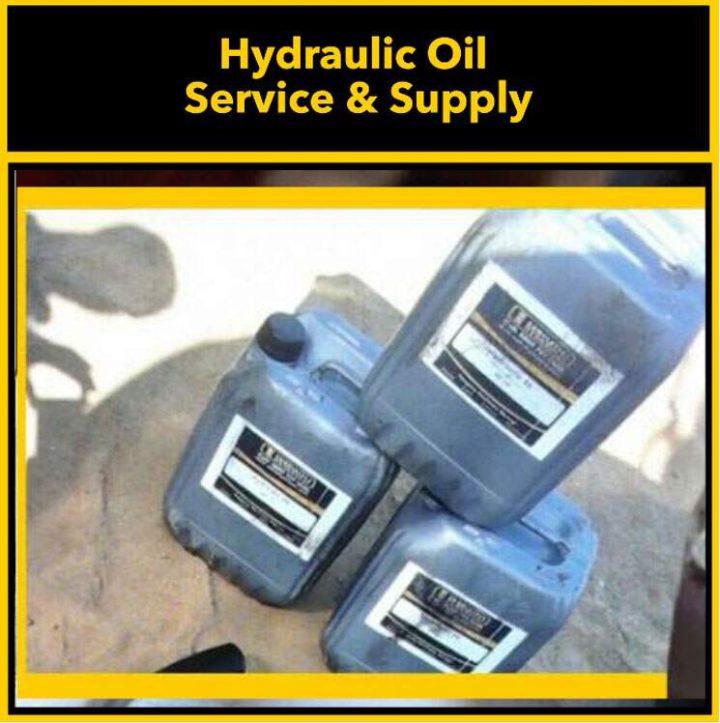
What Do ISO 32, ISO 46 & ISO 68 Mean?
ISO VG 32, ISO VG 46 and ISO VG 68 are commonly encountered hydraulic oil viscosity grades.
The number refers to the oil’s nominal kinematic viscosity at 40°C.
| ISO VG Grade | Nominal Viscosity at 40°C |
|---|---|
| ISO VG 32 | Approximately 32 mm²/s (cSt) |
| ISO VG 46 | Approximately 46 mm²/s (cSt) |
| ISO VG 68 | Approximately 68 mm²/s (cSt) |
The ISO VG number is a viscosity classification. It does not describe the complete oil specification.
Two fluids carrying the same ISO VG number can have different:
- Additive systems
- Base oils
- Viscosity-index characteristics
- Anti-wear performance
- Environmental properties
- Compatibility requirements
See our ISO 32, 46 and 68 hydraulic oil guide.
There is no universal hydraulic oil grade suitable for every machine. The correct viscosity and fluid specification should come from the equipment manufacturer or the engineering requirements of the hydraulic system.
How Temperature Changes Hydraulic Oil Viscosity
Hydraulic oil becomes more viscous as temperature falls and less viscous as temperature rises.
This relationship matters because the hydraulic components need the fluid to operate within an appropriate viscosity range.
Oil That Is Too Viscous
If the fluid is too viscous for the operating conditions, possible effects can include:
- Restricted flow
- Poor cold-start behaviour
- Sluggish hydraulic response
- Higher pressure losses
- Increased risk of pump inlet problems or cavitation
Oil With Insufficient Viscosity
If viscosity becomes too low for the component requirements, possible consequences can include:
- Reduced lubricating film
- Increased internal leakage
- Reduced hydraulic efficiency
- Increased wear
This is why selecting hydraulic oil solely according to ambient temperature can be misleading.
Is ISO 32 for Winter & ISO 68 for Hot Weather?
Not as a universal rule.
It is tempting to simplify hydraulic oil selection into:
- ISO 32 = cold weather
- ISO 46 = normal conditions
- ISO 68 = hot weather
But hydraulic systems are not all designed around the same pump, operating temperature, clearances or duty cycle.
The correct fluid should reflect:
- OEM specification
- Expected operating temperature
- Component requirements
- System design
- Fluid compatibility
- Operating environment
Read our hydraulic oil temperature and grade guide.
Not Sure Which Hydraulic Oil You Need?
Some machines require specialist or OEM-specific hydraulic oil. Using the wrong oil can cause serious damage.
Check Your Oil NowMain Types of Hydraulic Oil
“Hydraulic oil” covers several different fluid families and formulations.
Mineral-Based Hydraulic Oil
Mineral-based hydraulic fluids are widely used in industrial and mobile hydraulic systems.
Different formulations may provide properties such as:
- Anti-wear protection
- Oxidation resistance
- Corrosion protection
- Foam control
The correct product should still be selected according to the equipment specification.
High Viscosity Index Hydraulic Oil
High viscosity index fluids are designed to maintain their viscosity more consistently across a wider temperature range than some conventional fluids.
They can be useful in appropriate systems experiencing wide temperature variations, but should only be used where their specification is compatible with the equipment.
Synthetic Hydraulic Fluids
Synthetic fluids can be formulated for particular operating requirements, including demanding temperature or environmental conditions.
However, “synthetic” does not automatically mean that a fluid is suitable for every high-pressure or high-temperature hydraulic system.
Compatibility with seals, components, existing fluid and manufacturer requirements still matters.
Fire-Resistant Hydraulic Fluids
Fire-resistant hydraulic fluids are used where the application presents a significant fire hazard.
Different fire-resistant fluid technologies exist, and they can have very different characteristics.
A conventional mineral hydraulic oil should not simply be exchanged for a fire-resistant fluid without confirming that the system has been designed or approved for that fluid type.
Biodegradable & Environmentally Considerate Hydraulic Fluids
Biodegradable or environmentally acceptable hydraulic fluids may be specified where leakage could create particular environmental concerns.
Potential applications can include machinery operating around:
- Waterways
- Forestry
- Agriculture
- Environmentally sensitive sites
Again, biodegradability does not remove the need to check machine compatibility, viscosity and the complete fluid specification.
Re-Refined or Reclaimed Hydraulic Oils
Re-refined or reclaimed oils require the same fundamental specification checks as other hydraulic fluids.
Selection should be based on whether the actual finished fluid meets the requirements of the hydraulic system — not simply whether the base oil is new or reprocessed.
How Long Does Hydraulic Oil Last?
There is no universal 2,000-hour, 3,000-hour or annual replacement rule suitable for every hydraulic system.
Oil life can be affected by:
- Operating temperature
- Operating hours
- Duty cycle
- Contamination
- Water ingress
- Oxidation
- Fluid formulation
- Reservoir condition
- Filtration
- Machine environment
- Maintenance practices
- System condition
Some machines may operate under controlled conditions with effective filtration, while another system using a similar fluid may experience heavy contamination, high temperatures or water ingress.
The oil in those systems should not automatically be expected to have the same useful service life.
When Should Hydraulic Oil Be Changed?
The starting point should be the equipment manufacturer’s maintenance requirements.
Where appropriate, oil condition and analysis can provide additional information.
An oil change may be required because of:
- OEM maintenance requirements
- Excessive contamination
- Water ingress
- Oxidation or degradation
- Incorrect fluid
- Fluid incompatibility
- Major component failure
- Maintenance or system modification requirements
Changing oil unnecessarily can create cost and waste. Leaving unsuitable oil in service for too long can damage hydraulic components.
The objective is therefore to maintain the fluid in a condition suitable for the hydraulic system.
Signs Hydraulic Oil May Need Attention
Changes that justify investigation can include:
- Unexpected colour change
- Cloudy or milky appearance
- Foaming
- Unusual smell
- Visible contamination
- Sludge or deposits
- Repeated filter blockage
- Unexpected overheating
- Changes in machine behaviour
Appearance alone cannot reveal every important property of hydraulic oil, so a fluid that looks clean is not automatically suitable for continued service.
Read our signs hydraulic oil may need changing.
Hydraulic Oil Contamination
Contamination can enter a hydraulic system in several ways.
Sources can include:
- Dirty filling equipment
- Reservoir breathers
- Damaged seals
- Component wear
- Maintenance work
- Hose or component replacement
- Water ingress
- Condensation
- Contaminated new oil
Contaminants can include solid particles, water, air and degradation products.
These can affect pumps, valves, cylinders and other components in different ways.
New oil should not automatically be assumed to meet the cleanliness requirements of every hydraulic system simply because it has not previously been used. Filling and transfer practices, filtration and component cleanliness all matter.
Hydraulic Oil Cleanliness & ISO 4406
Particle contamination in hydraulic fluid can be reported using cleanliness codes such as ISO 4406.
The code represents particle populations at defined size thresholds, commonly expressed at:
- ≥4 µm(c)
- ≥6 µm(c)
- ≥14 µm(c)
A result may therefore be shown in a format such as 18/16/13.
However, there is no single ISO cleanliness code suitable for every hydraulic machine.
The required cleanliness depends on the sensitivity of the components, manufacturer recommendations and system design.
Hydraulic Filtration
Hydraulic filters help control selected contaminants circulating through a hydraulic system.
Depending on the design, filtration can include:
- Pressure-line filtration
- Return-line filtration
- Suction-side arrangements
- Off-line filtration
- Reservoir breathers
Choosing a filter purely by micron rating can be misleading.
Filter performance also needs to consider:
- Required cleanliness
- Flow
- Pressure
- Contaminant-holding capacity
- Restriction
- Component requirements
- System design
A finer filter is not automatically better if it creates inappropriate restriction or is unsuitable for the application.
When Should a Hydraulic Filter Be Changed?
As with oil, there is no single filter-change interval suitable for every hydraulic system.
Replacement can be based on:
- OEM requirements
- Differential-pressure indicators where fitted
- Operating hours
- Contamination history
- Machine environment
- Maintenance records
- System condition
Repeatedly blocked filters may indicate a wider contamination or component problem that deserves investigation.
Hydraulic Oil Analysis
Oil analysis can provide information that cannot always be obtained from visual inspection alone.
Depending on the analysis undertaken, useful information may include:
- Particle contamination
- Water
- Viscosity
- Wear-related material
- Fluid degradation
The appropriate analysis depends on the system and what needs to be established.
Oil analysis should therefore be used as a diagnostic and maintenance tool rather than assuming every machine requires the same testing programme.
Can You Mix ISO 32 & ISO 46 Hydraulic Oil?
Do not assume they can be mixed safely.
The fact that two fluids are both hydraulic oils — or that their viscosity grades are close — does not establish compatibility.
Different products may use different:
- Base oils
- Additive systems
- Viscosity modifiers
- Anti-wear chemistry
- Environmental formulations
Mixing can alter the resulting viscosity and performance characteristics.
Always confirm compatibility and equipment requirements before mixing fluids.
Read our guide to mixing ISO 32 and ISO 46 hydraulic oil.
Can You Change Hydraulic Oil Grade to Fix Overheating?
Changing to a more viscous oil is not a reliable first response to a hydraulic system that is overheating.
Excessive heat can be caused by:
- Internal leakage
- Pressure losses
- Flow restrictions
- Cooling problems
- Incorrect system settings
- Low oil level
- Contamination
- Incorrect viscosity
- Excessive operating duty
The cause should be diagnosed before changing the oil specification.
See our hydraulic troubleshooting and diagnostics guide.
Hydraulic Oil Change vs Filtration
An oil change and filtration solve different problems.
| Approach | What It Can Address | Important Limitation |
|---|---|---|
| Oil change | Removes existing fluid and replaces it with suitable new fluid | Does not automatically remove contamination elsewhere in the system |
| Filtration | Can remove selected contaminants depending on filtration method | Does not restore chemically degraded or incorrect oil |
| Flushing | Can be used in suitable circumstances to remove contamination from a hydraulic circuit | Not required for every routine oil change |
See our hydraulic flushing vs oil change guide.
When Is Hydraulic Flushing Needed?
Hydraulic flushing can be appropriate where contamination needs to be removed from more than the reservoir alone.
Situations that may justify investigation include:
- Major component failure
- Severe contamination
- Incorrect fluid
- System manufacture or modification
- Contamination introduced during repair
Flushing should not be presented as a mandatory step during every routine oil change.
Hydraulic Oil Change & Filtration Service
Completely Hydraulic provides hydraulic oil change and filtration support for suitable industrial and mobile hydraulic systems.
Depending on the equipment and work required, support can involve:
- Fluid assessment
- Oil replacement
- Filtration
- Filter replacement
- Contamination investigation
- System troubleshooting
- Fluid selection support
The work required should be based on the actual condition of the hydraulic system rather than assuming every machine needs the same maintenance package.
Hydraulic Oil Supply
Completely Hydraulic also supplies hydraulic oils and related products through its trade-counter network.
When selecting replacement fluid, useful information includes:
- Machine make and model
- OEM fluid specification
- Current oil
- Required viscosity grade
- Operating environment
- Application
If the existing oil is unknown, do not automatically top the system up with another product solely because it has a familiar ISO viscosity grade.
Emergency Hydraulic Oil Supply
A hydraulic oil shortage following a leak or hose failure can create additional downtime.
Before refilling the machine, however, the cause of the fluid loss should be identified and repaired.
Simply adding oil to a system that is still leaking does not resolve the fault and may create further fluid loss.
See our emergency hydraulic oil supply information.
Hydraulic Oil Maintenance
Effective fluid maintenance is more than changing the oil at a fixed calendar interval.
A maintenance strategy can consider:
- Correct fluid specification
- Oil level
- Operating temperature
- Visible condition
- Contamination
- Filtration
- Breathers
- Leaks
- Oil analysis where appropriate
- Maintenance and failure history
For critical equipment, trending changes over time can be more informative than relying on a single observation.
Download Our Hydraulic Oil Guide
For a convenient overview of Completely Hydraulic’s hydraulic oil support, download our hydraulic oil information PDF.
Hydraulic Oil Services Information
Hydraulic Oil Support Across Our Service Areas
Completely Hydraulic operates four hydraulic engineering and trade-counter locations:
- Essex — Harlow
- London — Dagenham
- Kent — Belvedere
- Heathrow — Hayes
Mobile hydraulic engineering support is also available across Birmingham and the West Midlands.
Visit our trade-counter page for current location information.
Frequently Asked Questions
How often should hydraulic oil be changed?
There is no universal hydraulic oil change interval. Follow the equipment manufacturer’s requirements and consider operating hours, oil condition, temperature, contamination, environment and maintenance history. Oil analysis may also help determine condition where appropriate.
Does hydraulic oil expire after 2,000 or 3,000 hours?
Not as a universal rule. Some maintenance programmes may specify hour-based intervals, but 2,000–3,000 hours should not be applied automatically to every hydraulic system.
What is the difference between ISO 32, 46 and 68 hydraulic oil?
They are different ISO viscosity grades. Their numbers represent nominal kinematic viscosity at 40°C. The ISO VG number does not describe the complete fluid specification.
Which hydraulic oil should I use?
Use the hydraulic fluid specification recommended by the equipment manufacturer or established for the hydraulic system. Viscosity, additives, base fluid, temperature and component compatibility can all matter.
Is ISO 46 the standard hydraulic oil?
No. ISO VG 46 is widely used, but it is not automatically correct for every hydraulic system.
Can I use ISO 68 instead of ISO 46 if my machine is overheating?
Do not change viscosity grade simply to compensate for overheating. Internal leakage, restrictions, cooling problems, contamination and system settings can all generate excessive heat and should be investigated first.
Can ISO 32 and ISO 46 hydraulic oil be mixed?
Do not assume they are compatible. The products may contain different base oils and additive systems, and mixing also changes the resulting viscosity. Confirm compatibility and equipment requirements first.
Does new hydraulic oil need filtering?
New oil should not automatically be assumed to meet the cleanliness requirement of every hydraulic system. Filling and transfer practices and the machine’s required cleanliness level should be considered.
Does changing hydraulic oil remove all contamination?
No. Contamination can remain in hoses, cylinders, valves, pipework, reservoirs and other parts of the circuit. The appropriate cleaning, filtration or flushing strategy depends on the system and contamination problem.
What makes hydraulic oil look milky?
A cloudy or milky appearance can indicate the presence of water, although proper assessment may be required to determine the fluid condition and source of contamination.
Do you supply hydraulic oil?
Yes. Completely Hydraulic supplies hydraulic oil and provides oil-related hydraulic engineering support through its trade counters and service network.
Get Priority Hydraulic Support & Trade Pricing
Jump the queue. Reduce downtime. Pay less for parts, labour and callouts.
✔ Priority response
✔ Lower rates day & night
✔ Trade discounts on parts
✔ 30-day credit terms (approved accounts)
Need Hydraulic Oil or Fluid-System Support?
Whether you need help identifying the correct oil, investigating contamination, changing hydraulic fluid or diagnosing a system problem, contact Completely Hydraulic.