Updated: 3 September 2026
A hydraulic power pack that becomes noisy, overheats, leaks, loses performance or stops operating does not automatically need replacing.
The fault may be within the pump, electric motor, valves, filtration, reservoir, hydraulic oil, electrical controls or elsewhere in the connected hydraulic system. Correct diagnosis should therefore come before deciding whether to repair, rebuild or replace the power unit.
Completely Hydraulic provides hydraulic power pack fault-finding, repair, component replacement and power unit engineering support through its mobile engineering and workshop network.
A faulty hydraulic power pack should be diagnosed before replacement. Common problems include pump wear, motor or electrical faults, contaminated or incorrect oil, blocked filtration, valve problems, overheating, aeration, cavitation and external leakage. Depending on the condition and availability of components, the appropriate solution may be an individual component repair, power-pack rebuild or complete replacement.
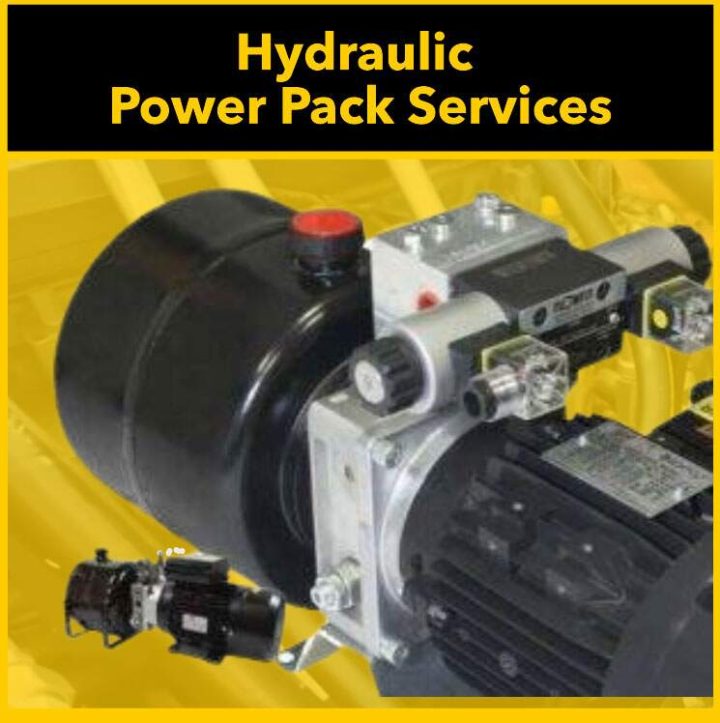
A hydraulic power pack — also known as a hydraulic power unit or HPU — provides hydraulic flow to operate machinery and equipment.
The exact configuration varies considerably between applications, but a power pack will commonly incorporate:
More complex units may also include accumulators, manifolds, oil coolers, heaters, level or temperature monitoring, instrumentation and additional control equipment.
The power pack is only one part of the hydraulic circuit. Poor machine performance does not necessarily mean the power pack itself has failed. Cylinders, valves, hoses, restrictions, contamination and other circuit problems can produce similar symptoms.
Hydraulic power units are used wherever a machine needs a dedicated source of hydraulic power.
Typical applications include:
The size and complexity of a power pack can range from a small compact unit to a substantial engineered hydraulic power system serving multiple machine functions.
| Symptom | Possible Areas to Investigate |
|---|---|
| Power pack will not start | Electrical supply, motor, controls, protection devices, mechanical loading or pump condition. |
| Machine operates slowly | Insufficient flow, pump wear, internal leakage, valve problems, restrictions or incorrect oil viscosity. |
| Low or unstable pressure | Pump condition, pressure-control valves, internal leakage, incorrect settings or wider circuit faults. |
| Excessive noise | Cavitation, aeration, low oil level, suction restriction, pump wear, incorrect fluid or mechanical issues. |
| Overheating | Internal leakage, restrictions, cooling problems, excessive pressure losses, unsuitable oil or inefficient operation. |
| Oil leaks | Hoses, fittings, seals, reservoir connections, valve blocks, pump or other components. |
| Foamy or aerated oil | Air ingress, low fluid level, return-line conditions, suction problems or other reservoir/circuit issues. |
| Repeated component failures | Contamination, incorrect specification, heat, pressure conditions or an unresolved system-level fault. |
Overheating is a symptom that should be investigated rather than simply treated by changing the hydraulic oil or replacing a component.
Possible causes include:
Hydraulic oil becomes less viscous as its temperature rises. Excessive heat can therefore affect lubrication, sealing, efficiency and component life as well as accelerating fluid degradation.
Changing to a thicker oil without identifying the cause of overheating can introduce further problems. The correct oil should follow the equipment and component requirements.
Some machines require specialist or OEM-specific hydraulic oil. Using the wrong oil can cause serious damage.
Check Your Oil NowA change in operating noise is often an early indication that something within the system needs attention.
Potential causes include:
Noise alone does not identify the failed component, which is why diagnosis is important before ordering a replacement pump or power pack.
Although both can cause abnormal noise and poor hydraulic performance, cavitation and aeration are different problems.
Cavitation can occur when the pump inlet does not receive fluid under suitable conditions, allowing vapour cavities to form and collapse. Restrictions, unsuitable fluid viscosity or other inlet problems may contribute.
Aeration involves air entering or becoming entrained in the hydraulic fluid. Possible sources include suction-side leaks, low reservoir level or unsuitable return conditions.
Both conditions can affect performance and may contribute to component damage if allowed to continue.
A useful diagnostic process considers the complete hydraulic system rather than immediately assuming the pump or power pack has failed.
A Practical Diagnostic Approach
1. Confirm the symptom
Establish exactly what the machine is doing differently — no movement, slow movement, noise, heat, leakage or inconsistent operation.
2. Inspect the fluid and reservoir
Check oil level, visible condition, contamination indicators and signs of aeration or leakage.
3. Inspect hoses, fittings and connections
Look for external leaks, damage, restrictions, poor routing or other obvious problems.
4. Assess the pump and drive
Consider pump condition, motor operation, coupling, suction conditions and abnormal noise.
5. Assess valves and circuit behaviour
Pressure-control, directional and flow-control components may affect machine performance.
6. Check operating conditions
System measurements and manufacturer information can help determine whether flow, pressure and temperature are consistent with the intended design.
7. Identify the root cause before repair
Replacing a damaged component without correcting the condition that caused the failure can result in the same problem returning.
For a broader fault-finding process, see the CH Hydraulic Troubleshooting Guide.
The correct decision depends on the condition of the unit, the fault, component availability, system requirements and the operational cost of downtime.
| Option | When It May Be Appropriate |
|---|---|
| Component Repair | The power pack is fundamentally suitable and the fault is confined to a repairable or replaceable component. |
| Power Pack Rebuild | Several components require attention but the existing unit remains suitable for the machine and can be economically restored. |
| Complete Replacement | The existing unit is extensively damaged, unsuitable, obsolete, uneconomical to repair or no longer meets the machine requirement. |
| Redesign / Upgrade | The machine duty or production requirement has changed, or the existing hydraulic design is contributing to recurring problems. |
Where the existing power pack is correctly specified and structurally serviceable, repairing or replacing the failed component may be the most practical solution. Where the unit is obsolete, badly damaged or unsuitable for the application, replacement or redesign may provide a better long-term result. Diagnosis determines which route makes sense.
The hydraulic pump is a common focus when a power unit loses performance, but it should not be condemned without considering its operating conditions.
A pump can be affected by:
If replacement is required, the new pump needs to match the application in areas such as pump type, displacement, rotation, mounting, shaft arrangement, operating pressure, flow and control configuration.
See our guide to hydraulic pump replacement.
A power-pack problem can also originate within its valve or manifold arrangement.
Depending on the system, valves may control:
A valve fault can sometimes produce symptoms that resemble pump failure, including slow movement, heat generation, incorrect pressure behaviour or an actuator that fails to operate as expected.
Before installing an expensive replacement component, it is important to consider the condition of the hydraulic fluid and the reason the original component failed.
Contamination can include solid particles, water, air, oxidation products and incompatible fluids.
If contaminated oil or another system problem contributed to the failure, fitting a new pump or valve without addressing the underlying cause may expose the replacement component to the same damaging conditions.
Read more about hydraulic contamination, removal and prevention.
Yes. In some applications an existing power pack can be modified or replaced to accommodate a change in machine requirements.
However, increasing pump capacity or changing components should not be treated as an isolated modification.
The engineer may need to assess:
Our guide to hydraulic system design explains why components need to be considered as part of the complete circuit.
Where an original power unit is obsolete or a machine requires a different hydraulic solution, a replacement unit may need to be specified around the actual application rather than simply copied from the old unit.
Depending on the project, this may involve selecting or engineering:
Completely Hydraulic supports hydraulic system engineering and OEM hydraulic solutions for new and existing machinery.
Jump the queue. Reduce downtime. Pay less for parts, labour and callouts.
✔ Priority response
✔ Lower rates day & night
✔ Trade discounts on parts
✔ 30-day credit terms (approved accounts)
The appropriate repair location depends on the fault and the work required.
Some faults can be investigated and corrected on-site by a mobile hydraulic engineer. More involved work may be better suited to a workshop where components can be removed, inspected and repaired under controlled conditions.
CH provides both mobile hydraulic engineering and hydraulic workshop repair capabilities.
Where a power pack failure stops critical machinery, Completely Hydraulic provides 24/7 mobile hydraulic engineering support.
The objective is to establish the fault and determine the most appropriate route to restoring the equipment — whether that means an on-site repair, replacement component, workshop repair or a more substantial power-unit solution.
Completely Hydraulic supports customers through its trade-counter and mobile engineering network.
Our four trade counters serve:
Birmingham and the wider West Midlands are supported through our mobile hydraulic engineering service.
For trade-counter information, locations and contact details, visit our Hydraulic Trade Counter Network.
A hydraulic power pack should not be replaced simply because the machine has lost pressure, become noisy or started overheating. Diagnose the complete circuit first. If the power unit is correctly specified and repairable, component repair or rebuilding may restore it. If it is obsolete, extensively damaged or no longer suitable for the machine, replacement or redesign may be the better engineering solution.
If your hydraulic power unit has stopped working, lost performance or is repeatedly causing problems, Completely Hydraulic can help diagnose the fault and determine whether repair, rebuilding or replacement is appropriate.
Possible causes include pump wear, pressure-control valve problems, internal leakage, low or unsuitable hydraulic oil, restrictions or faults elsewhere in the hydraulic circuit. Diagnosis is needed to identify the actual cause.
Yes. Depending on its condition and design, faults involving pumps, motors, valves, seals, filtration, electrical components and other power-unit components may be repairable or replaceable without changing the complete unit.
Replacement may be appropriate where a unit is extensively damaged, obsolete, uneconomical to repair or no longer suitable for the machine’s operating requirements.
Overheating can result from internal leakage, restrictions, pressure losses, cooling problems, unsuitable oil, excessive duty, contamination or worn components. The cause should be diagnosed before changing oil grade or replacing components.
Abnormal noise may be associated with cavitation, aeration, pump wear, low oil level, suction restrictions, incorrect oil viscosity or mechanical problems.
The hydraulic pump is one component that creates flow. A hydraulic power pack is the complete power unit and can include the pump, motor, reservoir, valves, filtration, controls and associated equipment.
Yes, but any modification should be assessed as part of the complete hydraulic system. Changes to pump flow, pressure, motor power or valve capacity can affect other components and machine behaviour.
Where the original unit is obsolete, a replacement may be specified around the machine’s actual hydraulic requirements, available space, control requirements and existing circuit connections.
Completely Hydraulic provides 24/7 mobile hydraulic engineering support for breakdowns. The appropriate repair route depends on the fault, component availability and the work required.
Yes. Completely Hydraulic provides workshop hydraulic repair capabilities alongside its mobile engineering service. More involved repairs may be transferred to the workshop where appropriate.