

Hydraulic Valves: Types, Functions & Common Problems
Updated: 27 August 2026
Hydraulic valves control how fluid moves through a hydraulic system. Depending on the valve type, they can control direction, pressure, flow or prevent reverse movement of hydraulic fluid.
Valves work alongside pumps, cylinders, motors, hoses and other hydraulic components to control machine movement and system behaviour.
Choosing the correct valve means understanding not only its physical size and connection type, but also its hydraulic function, pressure capability, flow requirement and control method.
For a wider overview of how valves fit into the complete circuit, see our
hydraulic systems guide.
Not Sure Which Hydraulic Oil You Need?
Some machines require specialist or OEM-specific hydraulic oil. Using the wrong oil can cause serious damage.
Check Your Oil NowQuick Answer: What Does a Hydraulic Valve Do?
A hydraulic valve controls the movement of hydraulic fluid within a circuit.
Depending on the valve type, it may start or stop flow, change flow direction, regulate pressure, control flow rate or prevent reverse flow.
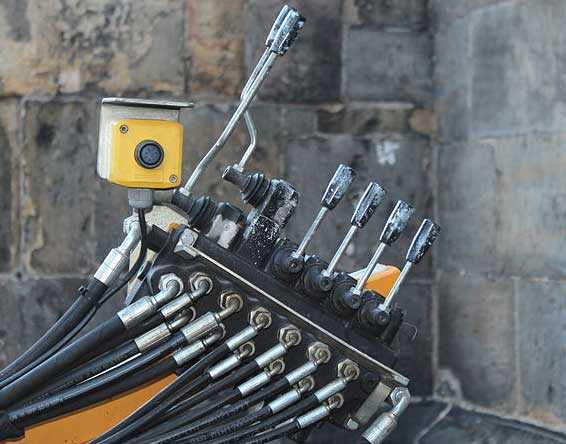
The main hydraulic valve categories are directional-control valves, pressure-control valves, flow-control valves and check valves.
How Do Hydraulic Valves Work?
Hydraulic valves contain internal passages that open, close or change according to the position of moving elements such as spools, poppets or cartridges.
When these internal elements move, they alter the hydraulic path through the valve.
This allows the system to:
- Direct hydraulic fluid towards an actuator
- Stop or start a machine function
- Limit or regulate pressure
- Control actuator speed
- Allow flow in one direction while blocking it in another
- Sequence or coordinate hydraulic functions
Engineering Point
A hydraulic valve is part of a complete circuit. Poor performance at a cylinder or motor does not automatically mean the valve has failed. Pump condition, oil, contamination, pressure, flow and connected components can all influence the same machine function.
What Are the Main Types of Hydraulic Valves?
| Valve Type | Primary Function | Typical Use |
|---|---|---|
| Directional-Control Valve | Changes the path of hydraulic flow | Extend, retract, start, stop or reverse actuators |
| Pressure-Control Valve | Controls or limits hydraulic pressure | System protection and pressure regulation |
| Flow-Control Valve | Controls hydraulic flow rate | Influence actuator speed |
| Check Valve | Allows flow in one direction and restricts reverse flow | Hold pressure or prevent unwanted backflow |
What Is a Directional-Control Valve?
A directional-control valve determines where hydraulic fluid travels within the circuit.
These valves are commonly used to control functions such as:
- Extending a hydraulic cylinder
- Retracting a hydraulic cylinder
- Starting or stopping a hydraulic motor
- Reversing motor direction
- Switching between machine functions
Many directional valves use an internal spool that moves between different positions and connects or blocks the internal ports.
Spool movement may be controlled manually, mechanically, electrically, hydraulically or pneumatically depending on the system design.
Simple Example
On a double-acting cylinder, a directional valve can send pressurised fluid to one side of the piston while allowing fluid to return from the opposite side. Moving the valve to another position reverses those flow paths.
What Is a Pressure-Control Valve?
Pressure-control valves influence the pressure within parts of the hydraulic circuit.
Different designs can perform functions such as:
- Limiting maximum system pressure
- Reducing pressure in part of a circuit
- Maintaining a required back pressure
- Controlling the sequence of hydraulic operations
- Helping protect components from excessive pressure
A common example is a pressure-relief valve, which is used to limit pressure by providing an alternative flow path when a set pressure is reached.
Pressure Settings Should Not Be Changed Arbitrarily
Increasing a valve setting to make a machine produce more force can expose hoses, pumps, cylinders and other components to pressures beyond their intended design. System pressure settings should follow the machine and component specifications.
What Is a Flow-Control Valve?
Flow-control valves regulate the amount of hydraulic fluid passing through part of a circuit.
Because hydraulic actuator speed is closely related to flow, these valves can be used to influence how quickly a cylinder moves or a hydraulic motor rotates.
Flow-control valves may be:
- Fixed
- Adjustable
- Pressure compensated
- Combined with check-valve functions
Pressure and Flow Are Different
Pressure contributes to force or torque, while flow strongly influences actuator speed. A machine operating slowly may therefore have a flow problem rather than simply a pressure problem.
What Does a Hydraulic Check Valve Do?
A check valve is designed to allow hydraulic fluid to flow in one direction while restricting or preventing flow in the opposite direction.
Depending on the circuit, check valves can help:
- Prevent unwanted reverse flow
- Maintain fluid in part of a circuit
- Protect pumps from reverse flow
- Work alongside flow-control valves
- Support load-holding arrangements
Some check valves are pilot operated, allowing them to remain closed until hydraulic pilot pressure intentionally opens them.

How Are Hydraulic Valves Installed?
Hydraulic valves are produced in many physical formats and mounting styles.
Examples include:
- Inline threaded valves
- Subplate-mounted valves
- Manifold-mounted valves
- Cartridge valves
- Flanged valves
- Valve-bank assemblies
The correct design depends on the hydraulic circuit, flow requirement, pressure rating, available space and maintenance requirements.
Need a fast hydraulic repair quote?
Tell us what’s failed — we’ll get back to you quickly.
What Are Common Hydraulic Valve Problems?
Hydraulic valves can develop faults through wear, contamination, electrical problems, incorrect settings or damage elsewhere in the circuit.
Common symptoms can include:
- Machine function not responding
- Actuator moving in the wrong direction
- Slow or inconsistent movement
- Hydraulic pressure behaving incorrectly
- Valve spool sticking
- Internal leakage
- External hydraulic oil leakage
- Valve not shifting fully
- Electrical solenoid failure
- Excessive heat
- Unusual vibration or noise
A Valve Fault Can Look Like Another Hydraulic Problem
Slow cylinder movement, low force or erratic operation can also be caused by pump wear, restricted filters, air, unsuitable oil, internal cylinder leakage or other circuit faults. Diagnosis should consider the complete system before replacing the valve.
Can Contaminated Hydraulic Oil Damage Valves?
Yes.
Many hydraulic valves contain small internal clearances and precision surfaces.
Contamination can contribute to:
- Spool sticking
- Accelerated surface wear
- Blocked small passages
- Seal damage
- Incorrect valve movement
- Internal leakage
Maintaining clean hydraulic oil and suitable filtration is therefore important for valves as well as pumps and actuators.
See our hydraulic oil guide and preventative hydraulic maintenance information.
What Is a Solenoid Hydraulic Valve?
A solenoid-operated hydraulic valve uses an electrical coil to create movement within the valve mechanism.
Electrical control allows hydraulic functions to be operated through machine switches, control systems or automation.
If a solenoid valve does not operate correctly, the cause could involve:
- The hydraulic valve itself
- The solenoid coil
- Electrical power supply
- Wiring or connectors
- Control signal
- Contamination preventing mechanical movement
Hydraulic and Electrical Diagnosis May Both Be Required
On electrically operated hydraulic machinery, replacing a valve without checking its electrical control can lead to unnecessary component replacement.
How Do You Choose the Correct Hydraulic Valve?
Valve selection should be based on the circuit and machine requirements rather than visual similarity.
Important factors include:
- Valve function – direction, pressure, flow or check-valve duty
- Working pressure
- Required flow rate
- Port size and connection type
- Number of valve positions and ports
- Control method – manual, mechanical, electrical or hydraulic
- Mounting style
- Hydraulic fluid compatibility
- Machine manufacturer specification
Match the Valve to the Circuit
A valve that physically fits the machine is not necessarily hydraulically suitable. Flow capacity, pressure rating, spool configuration and control function all need to match the intended circuit.
Can Hydraulic Valves Be Repaired?
Some hydraulic valves can be repaired or serviced, while others are more practical to replace.
The decision depends on:
- Valve type
- Extent of wear or damage
- Availability of seals and internal components
- Condition of precision internal surfaces
- Electrical condition where solenoids are fitted
- Cost of repair compared with replacement
- Availability of a suitable replacement valve
| Repair May Be Appropriate | Replacement May Be Appropriate |
|---|---|
| Serviceable valve body and replaceable seals/components | Severe spool, bore or body damage |
| Known fault with available parts | Obsolete or unavailable repair components |
| Repair remains technically and economically practical | Repair cost approaches the cost of a suitable replacement |

Hydraulic Valve & System Engineering Support
Completely Hydraulic supports hydraulic systems used in industrial machinery, mobile plant and specialist equipment.
Our wider hydraulic engineering support can include:
- Hydraulic fault diagnosis
- Hydraulic valve assessment and replacement
- Valve-bank and manifold support
- Hydraulic pump support
- Hydraulic hose repair and replacement
- Hydraulic cylinder and ram repair
- Hydraulic oil and contamination-related support
- Mobile hydraulic engineering
- 24/7 on-site hydraulic support
Keeping Machinery Moving.
Hydraulic Valves, Components & Trade Counter Support
Hydraulic valves, fittings, hoses, adapters, oils and related components can also be supported through Completely Hydraulic’s trade-counter network.
Our trade counters serve:
- Essex
- London
- Kent
- Heathrow and West London
Where possible, bringing the original component, photographs, machine details and any visible identification markings can make valve identification easier.
Find your nearest
hydraulic trade counter.
Quick Hydraulic Valve Summary
DIRECTIONAL VALVES
Control where hydraulic fluid travels.
PRESSURE VALVES
Limit, reduce or otherwise control hydraulic pressure.
FLOW VALVES
Control fluid flow and therefore influence actuator speed.
CHECK VALVES
Allow flow in one direction while restricting reverse flow.
COMMON PROBLEMS
Contamination, internal wear, sticking, leakage, incorrect settings and electrical faults.
KEY RULE
Diagnose the complete hydraulic circuit before assuming the valve itself is responsible.
Related Hydraulic Guides & Services
Need Help With a Hydraulic Valve or System Fault?
If a hydraulic function is slow, stuck, leaking, operating in the wrong direction or failing to respond, Completely Hydraulic can help assess the valve and the wider hydraulic circuit.
Hydraulic Valve FAQs
What does a hydraulic valve do?
A hydraulic valve controls hydraulic fluid within a circuit. Depending on the valve type, it can change flow direction, regulate pressure, control flow rate or prevent reverse flow.
What are the main types of hydraulic valves?
The main categories are directional-control valves, pressure-control valves, flow-control valves and check valves.
What is a directional-control valve?
A directional-control valve changes the path of hydraulic fluid so that functions such as cylinder extension, retraction or hydraulic motor direction can be controlled.
What does a hydraulic relief valve do?
A relief valve helps limit hydraulic pressure by allowing fluid to follow an alternative path when the set pressure is reached.
What does a hydraulic flow-control valve do?
A flow-control valve regulates hydraulic flow rate and can therefore influence how quickly cylinders or hydraulic motors operate.
What does a hydraulic check valve do?
A check valve allows hydraulic fluid to flow in one direction while restricting or preventing reverse flow.
Why do hydraulic valves fail?
Possible causes include contamination, internal wear, sticking components, damaged seals, incorrect settings, pressure or flow problems and electrical faults on solenoid-operated valves.
Can contaminated oil cause a hydraulic valve to stick?
Yes. Contamination can interfere with precision internal clearances and small passages, contributing to sticking, wear and incorrect valve operation.
Can hydraulic valves be repaired?
Some valves can be serviced or repaired depending on their design and condition. Others may be more practical to replace where internal damage is severe or suitable parts are unavailable.
Does Completely Hydraulic provide hydraulic valve support?
Yes. Completely Hydraulic provides hydraulic fault diagnosis, valve and component support, mobile hydraulic engineering and wider hydraulic-system repair services.